Contents
How to read a face score: first, relative to what?A face score has spread: another photo, another numberOne number sums many readings: read the partsThree rules: like with like, parts first, never one resultHow FacialRate does it: more than one numberFAQKey points
- Relative: a different group of raters can move the average by about a point; a recalibrated tool makes old scores incomparable.
- Spread: when scores bunch in the middle, two or three points is noise, not a finding.
- Summary: read the parts to see what changed between two results.
- A score describes a photo. It does not measure a person's worth.
How to read a face score: first, relative to what?
A number on its own says nothing. A 7, a 75: compared with whom?
A face rating model is built from a set of photos and a set of people’s ratings. In one common 2018 dataset, 5,500 front-facing photos were each rated by 60 volunteers, and their average is the “answer”. A model’s number estimates what that group would say about your photo.
Change the reference and the number moves. In one study, two groups of judges rating the same photos landed about a point apart on average, on a 7-point scale. One face-rating site recalibrated its scores once, and older scores stopped being comparable with new ones.
So read the scale and the reference first: out of what, compared with which faces, on which scoring basis.
A face score has spread: another photo, another number
A 2011 study had 40 people rate 20 photos each of 20 people. Choose the photos well and you could reverse which of any two people was rated more attractive. Raters drift too: the same person rating the same faces a week later correlated about 0.80 with their first ratings, not 1.
The site that published its scores showed them bunched in the middle: mean 71.5, median 75, top 10% at 84 or more. Packed that tightly, two or three points say little.
Say two photos score 74 and 77 (a hypothetical). Don’t conclude yet: score a few more taken the same way and see whether those 3 points are noise. Why photos move scores: why does my face score change.
One number sums many readings: read the parts
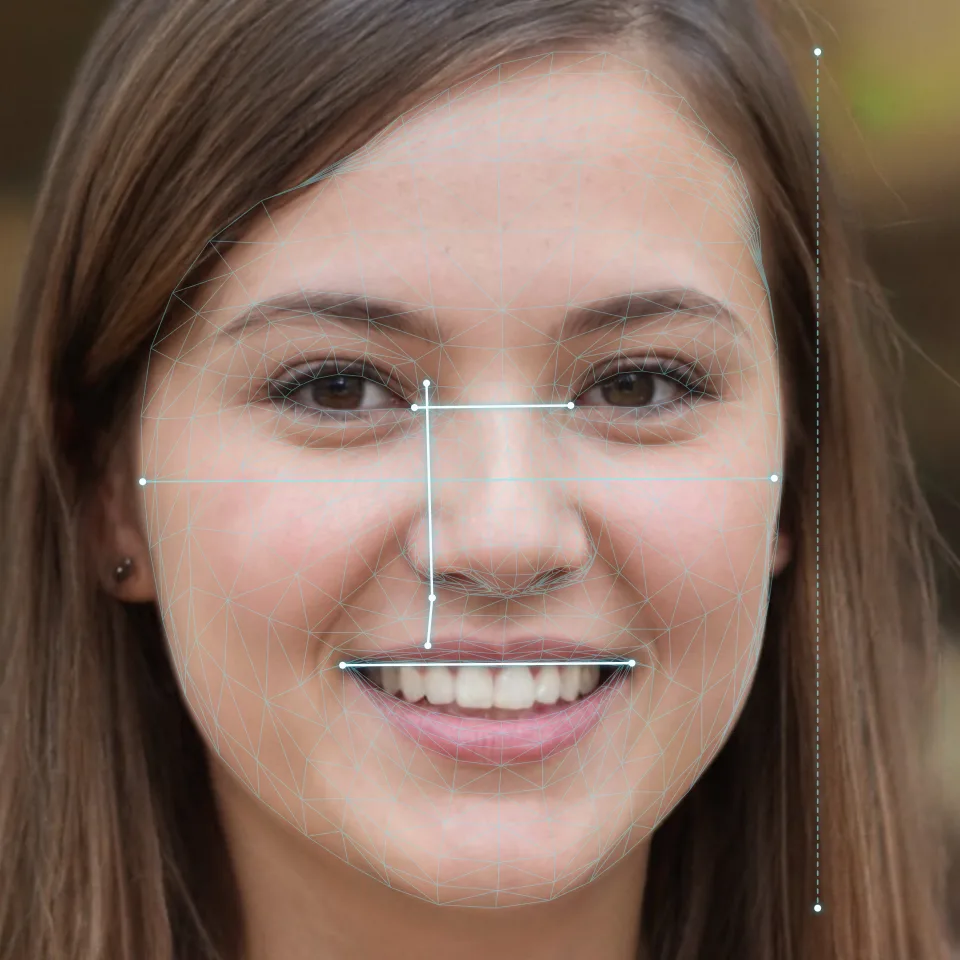
Read only the total and you can’t tell what moved.
Any face-rating tool starts by finding points on the face and computing ratios from them. The diagram shows a few lengths commonly used. On the same sample photo, some other readings: jaw width ÷ cheekbone width 0.79, middle third ÷ lower third 0.99, and eye height ÷ eye length 0.29 and 0.31. That last one runs low because the photo is smiling, and a smile narrows the eyes.
When two results differ, see which reading changed. Eye readings moved? Think expression. Symmetry moved? Think head turn.
Some tools score from one fixed ratio, such as the golden ratio. Research links it only weakly to ratings; see is the golden ratio face reliable.
Three rules: like with like, parts first, never one result
- Like with like: compare only results from the same tool, the same scoring basis and the same photo setup. Scores on different scales don’t mix.
- Parts first: read each reading and its note, then the total. The parts show what is doing the work.
- Never one result: take three under the same conditions and note the spread. Changes inside it are noise.
The rule that matters most: a score describes the impression one photo tends to make on a certain group of raters. It does not measure a person’s worth, and it doesn’t rank people.
Setup: front-facing photo. Accuracy: are AI face ratings accurate.
How FacialRate does it: more than one number
FacialRate’s score comes from a machine-learning model that learned from real human ratings, not a hand-picked fixed formula like a golden-ratio calculator. It was calibrated and tested against real ratings.
And it gives you more than one number. The free face report shows:
- your face type;
- your strongest feature;
- three highlights;
- a reading of 11+ dimensions;
- one tip to try.
That’s the “parts first” rule built in: beside the total, you see what each reading says. The full report is an optional one-time purchase, not a subscription.
Read it by the same three rules.
FAQ
An attractiveness test gave me 6. Is that high or low?
Check the scale and the reference first: out of what, compared with which faces. Your own results, taken the same way, are a better comparison than other people's scores.
Why does my own rating differ from the face rating I got?
In studies, people rate themselves about a point higher than others rate them. Looking at high-rated faces first also lowers how people rate themselves.
Should I read the total or the parts first?
The parts. The total sums many readings; when two results differ, the parts show where.