Contents
What makes a face attractive? The research answer is shortHow solid is each cue? Look at who was measuredCheck the three cues on one photo yourselfShared taste, private taste, and the faces you just sawHow FacialRate does itFAQKey points
- A group's average judgement is very consistent; two individual raters agree only moderately.
- In a 2017 study, averageness and symmetry predicted ratings in one set of faces and not in another.
- Raters shown only cheek skin preferred even colour; lightness itself did not predict ratings.
- A face rating describes how one photo looks to a group of raters. It does not rank people.
What makes a face attractive? The research answer is short
Three cues: closeness to average, left-right symmetry, even skin. They recur across decades of studies.
First, do people even agree? A 2000 meta-analysis pooled dozens of studies. A group’s average rating is very stable: about 0.90 within a culture, 0.94 across cultures. Two individual raters agree only about 0.47 and 0.71.
Averaged over many people, judgements point to the same faces; you and I, one on one, often differ. So the cues answer “which faces does a group prefer on average”, not “what will this person think”.
How solid is each cue? Look at who was measured
Averageness and symmetry. A 2017 study photographed 181 people under fixed conditions and had online raters score them. In one set of faces both cues predicted attractiveness (0.28 and 0.30); in the other, neither did (0.05 and 0.10). Both were judged by eye, not measured.
Skin. In the same study, skin lightness and hue did not predict ratings. Evenness did: in a 2007 study, 353 raters saw 170 crops of cheek skin, and more even colour was rated more attractive and healthier (r above 0.40), tracking redness and pigment (0.92, 0.68). That holds in that study’s samples; it was industry-funded.
The field’s own limits: lab photos, student raters, scales that differ.
Check the three cues on one photo yourself
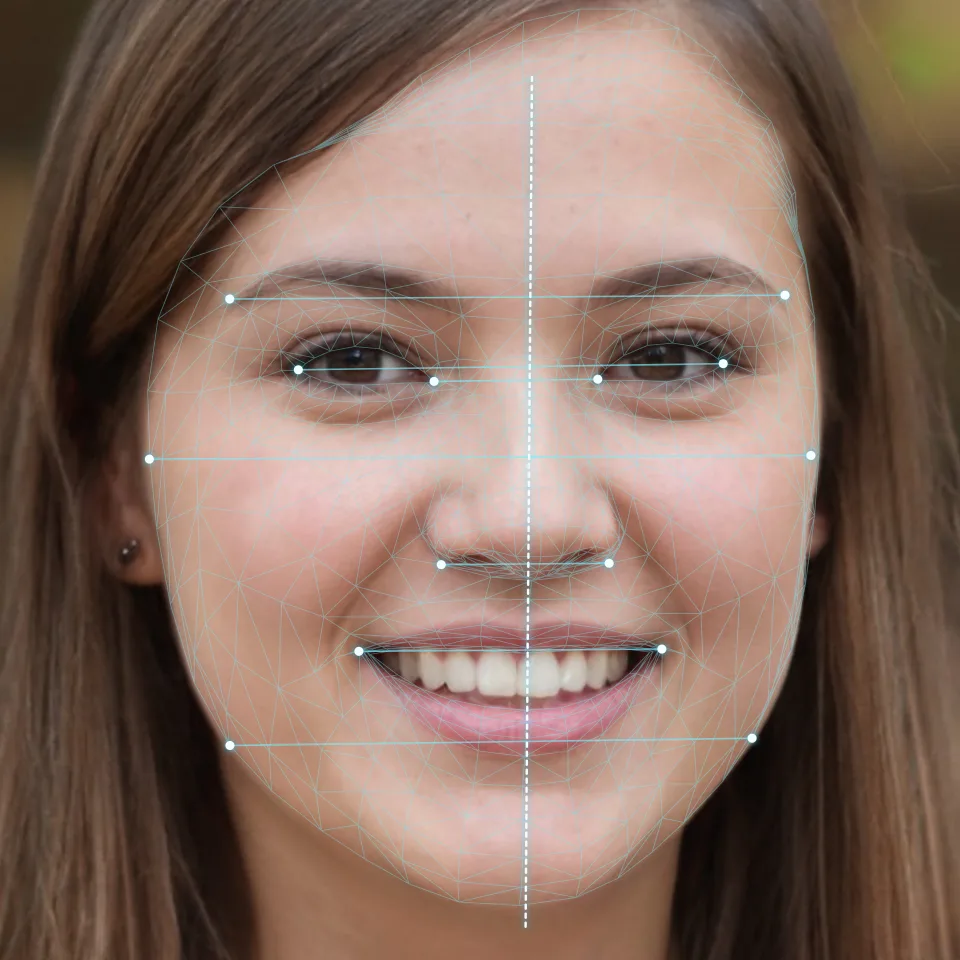
Don’t eyeball it. Measure.
- Symmetry: on the diagram’s seven pairs of points, check whether all lean the same way. If they do, the head is probably turned. The sample’s eye line tilts about 0.4°; turning is a separate check (facial symmetry). A mirrored half-face is a face that doesn’t exist. Talking pulls the mouth sideways, so keep it closed.
- Skin: sample a patch on each cheek and the forehead. Under even light the sample reads 201, 197 and 191 (of 255); see skin evenness.
- Averageness: one photo can’t show it; it belongs to a set of faces (average face).
Most real faces don’t fit classical rules like equal thirds or the golden ratio; “proportionate” means within the usual range. The sample’s middle-to-lower third ratio, 0.99, is one reading, not a standard.
Shared taste, private taste, and the faces you just saw
In a 2016 study, people rated the same 100 faces twice, a week apart. Private taste made up about 36–44% of the meaningful variation, close to a 2006 finding. Two raters agreed at about 0.48–0.58; one rater with themselves a week later, about 0.80, not 1.
Culture and era shift the standard too: what you see often shapes your mental “typical face”. Even the last few faces matter; people shown highly rated faces first then rate themselves lower.
So none of this ranks people. It describes what a group of raters preferred, on average, on a batch of photos. Any attractiveness test or “rate my face” tool works the same way: a score describes a photo, not a person’s worth.
How FacialRate does it
FacialRate’s face analysis reads 11+ dimensions, symmetry and proportions among them, and the face report adds your face type, your strongest feature, three highlights and one tip to try. The overall face score isn’t those readings added up, nor a fixed formula like a golden-ratio calculator. It comes from a machine-learning model that learned from real human ratings, calibrated and tested against them. The studies above are cues, not its recipe.
It also says plainly that a score describes this photo: light, angle and expression change what the model sees. Tips cover only photography, hair, makeup and skincare. Detection runs on your device, the photo is never uploaded, and it’s free with no limit on tries.
FAQ
Is a more symmetrical face always more attractive?
No. In the 2017 study, symmetry mattered in one set of faces and not in the other. A "symmetric" face built by mirroring half a face often looks odder, not better.
Does skin tone affect a face score?
In that study's natural photos, lightness and hue did not predict ratings; evenness did. Shoot in even, front-on light so you read the skin and not the lamp.
Does an AI face analyzer score faces with these rules?
Not necessarily. Many tools learn from human ratings. These studies help you guess what a model might pick up, but they are not its formula.