Contents
Face proportions: five ratios are enoughFive ratios in one tableThe first three each have their own pageMouth ÷ nose: two classical rulesFeature placement: three lines across, two downTwo lessons that apply to all fiveFAQKey points
- The five: middle ÷ lower third, eye gap ÷ eye length, length ÷ cheekbone width, mouth ÷ nose width, and the heights of the eye, nose and mouth lines.
- Ratios have no units. What matters is one photo, taken one way, for all five.
- The rules of thumb come from drawing and classical canons; real faces rarely match them exactly.
- A ratio is a ruler, not a grade.
Face proportions: five ratios are enough
Face proportions sound like rules to memorise. In practice, five divisions do it. Each ratio divides one length by another and answers one plain question: how is the height shared out, how much space sits between the eyes, is the face long or wide, which is wider, mouth or nose, and how high do the features sit?
Zooming the photo changes nothing, and no single ratio says whether a face looks good. They are five rulers, each measuring one thing.
Five ratios in one table
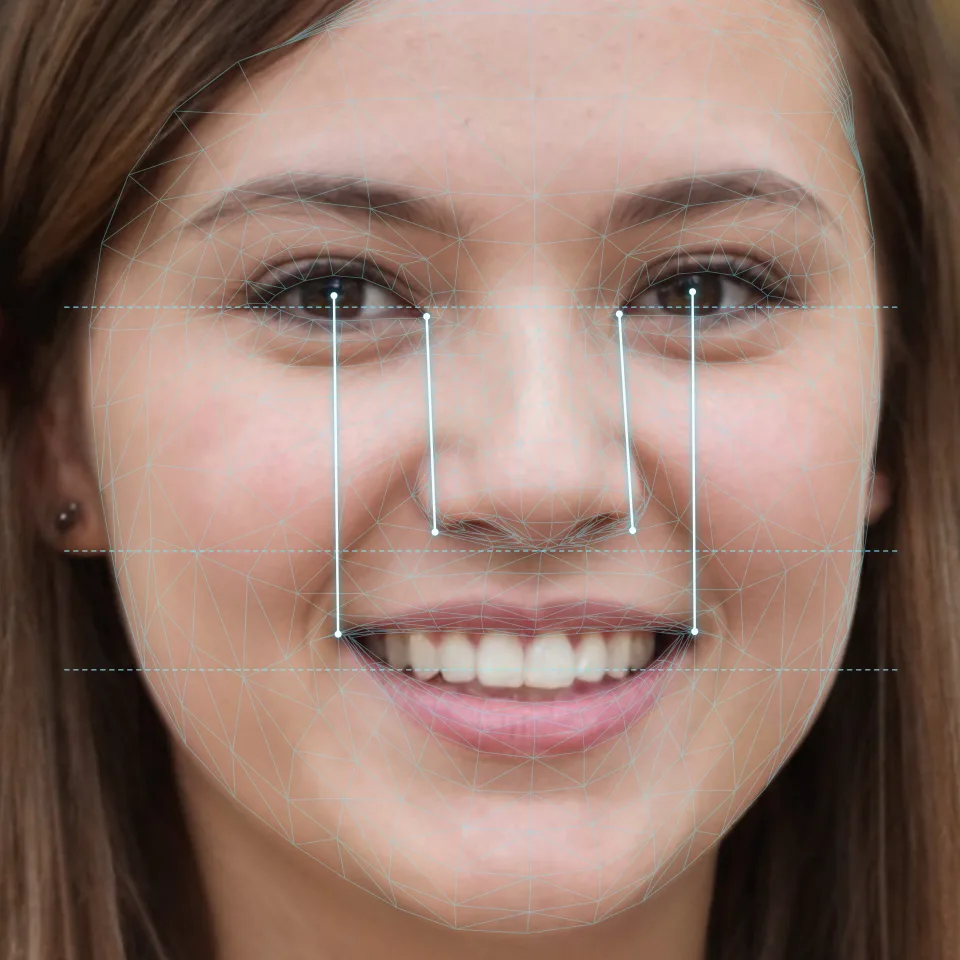
Pixels on the sample photo. She is smiling, which matters later.
| Ratio | Measure | Sample | Rule of thumb | Read more |
|---|---|---|---|---|
| Middle ÷ lower third | Brow to nose base; nose base to chin | 284 ÷ 286 = 0.99 | 1:1 | Facial thirds |
| Eye gap ÷ eye length | Inner eye corners; one eye | 144 ÷ 115 = 1.25 | About 1 | Eye spacing |
| Length ÷ width | Hairline to chin; cheekbones | 789 ÷ 582 = 1.36 | Guides differ | Face shape |
| Mouth ÷ nose | Mouth corners; nostril wings | 267 ÷ 148 = 1.80 | About 1.5 | Below |
| Placement | Eye, nose and mouth lines; two verticals | Eye line at 41% | Inner eye over nostril, pupil over mouth corner | Feature placement |
Eye length is the average of 120 and 110.
The first three each have their own page
- Middle ÷ lower third. The steadiest reading of the thirds: clear end points, no hairline. Method and errors are in facial thirds. The sample gives 0.99.
- Eye gap ÷ eye length. The rule says one eye fits between the eyes. The sample’s gap is a quarter longer than the average eye, common on real faces. See eye spacing.
- Length ÷ cheekbone width. The face-shape ratio, a whole-face cousin of the facial width-to-height ratio (fWHR), and the one most sensitive to its start point. From the hairline the sample gives 1.36; the face shape guide starts lower on the forehead and gets 1.19 for the same face. The often-quoted 1.618 is far off either way; see golden ratio face.
Mouth ÷ nose: two classical rules
Classical canons have two rules about the nose:
- The mouth is about 1.5 times as wide as the nose.
- The nose is about as wide as the gap between the inner eye corners, or in drawing-class terms, the nostril wings sit below the inner eye corners.
On the sample, the nose is 148 and the eye gap 144: the second rule holds. The mouth is 267, or 1.80 noses. But she is smiling, and a smile pulls the corners outward. Measure this with relaxed, closed lips.
Real faces often miss both. A 2006 study of 50 healthy adults found the nose several millimetres wider than the inner-eye gap on average. Mouth width varies little between people and nose width a lot, so most of this ratio’s movement comes from the nose.
Feature placement: three lines across, two down
The last checks position: how high do the eye, nose-base and mouth lines fall? Two verticals from drawing class: inner eye corner above the nostril wing, pupil above the mouth corner.
On the sample the eye line sits 41% of the way from hairline to chin. Guides that put the eyes halfway measure the whole head from its top. Both verticals line up, though the mouth one is weakened by the smile. More in feature placement.
Two lessons that apply to all five
One photo for everything. Face the lens, head level, 1.5–2 m away, relaxed; the setup is in facial thirds. Change the photo and several ratios move at once. Mouth width reacts most to a smile; the eye line moves when you tilt your head. If you would rather not measure by hand, a face report built from one front-facing photo lists these ratios in one place.
A ratio is a ruler, not a grade. Tested directly, classical rules predict attractiveness ratings poorly. Harmony depends on how the parts go together, not on which number sits closest to a canon; see facial harmony. For why people often prefer features close to the typical, see average face.
FAQ
Is there a standard for face proportions?
Rules of thumb, not a standard. Equal thirds, one eye between the eyes and a mouth 1.5 noses wide come from drawing and classical canons.
Which ratio should I look at first?
Middle third ÷ lower third. Its end points are the clearest and it ignores the hairline. Mouth ÷ nose changes most with a smile, so leave it for last.
Can I measure a selfie?
Yes, if it was taken from 1.5–2 m, whether you divide by hand or use a facial ratios calculator. A front camera held at arm's length enlarges the middle of the face, so nose width, eye spacing and the middle third read a little off, and only photos taken the same way can be compared.