Contents
Facial feature placement: three lines across, two downThe eye line: 41% of the face, half of the headThe base of the nose and the mouth lineTwo verticals: inner eye over nose, pupil over mouth cornerExpression, angle, makeup and hair all move the linesFAQKey points
- Three lines across: eyes, nose base, mouth. Note where each falls between hairline and chin.
- "Eyes at half" starts at the top of the head. From the hairline, the eye line lands above half.
- Two verticals: inner eye corner over nostril wing, pupil over mouth corner. Both hold on the sample; the smile weakens the second.
- Expression and head tilt move the lines. Makeup and bangs move where the eyes seem to sit.
Facial feature placement: three lines across, two down
Five lines on one front photo show how high the eyes, nose and mouth sit and whether they line up:
- Three across: the eye line (height of the eye corners), the base of the nose, and the mouth line (where the lips meet). Divide each one’s distance from the hairline by the hairline-to-chin length to get a percentage.
- Two down, both drawing-class checks: is the inner eye corner right above the outer nostril wing, and the pupil right above the mouth corner?
The lines describe; they don’t grade. Take the photo as for facial thirds. If you would rather not draw the lines, a face report built from that photo lists feature placement with the other ratios.
The eye line: 41% of the face, half of the head
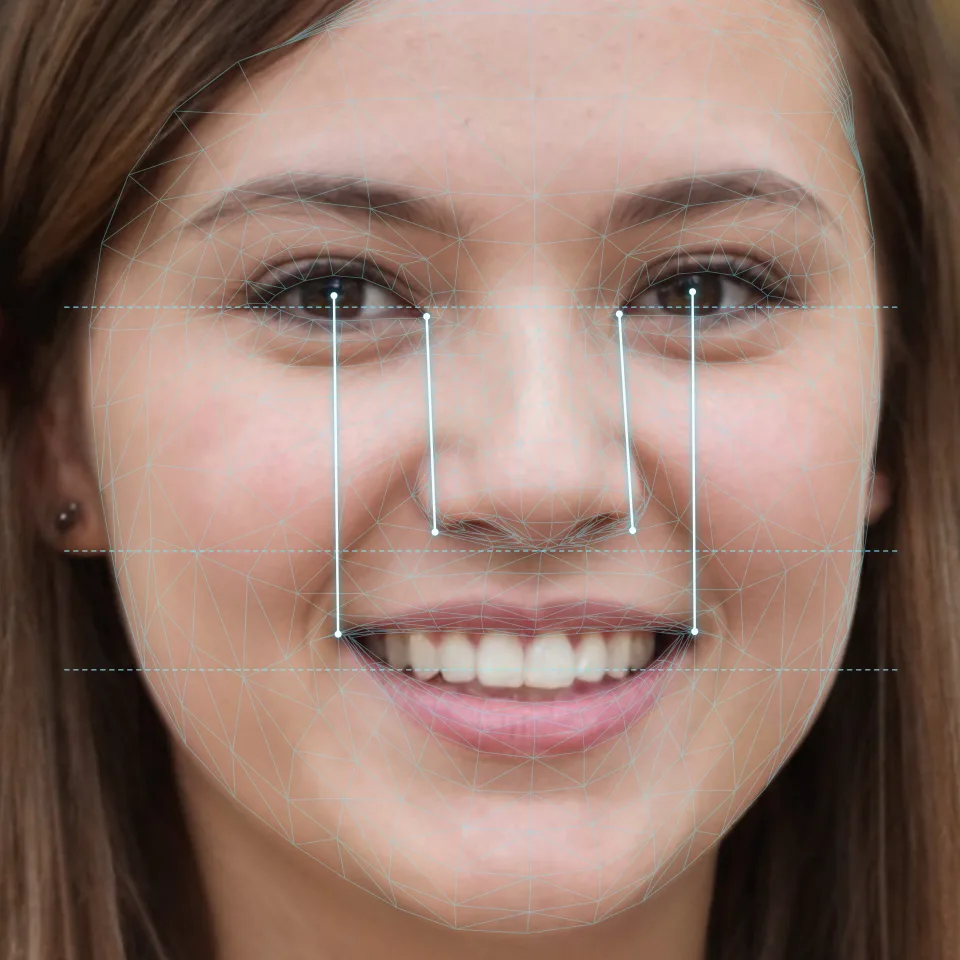
On the sample photo the eye line sits 41% of the way from hairline to chin, a little above halfway.
Many drawing guides say the eyes are halfway down the head. Both are right; they start in different places:
- Drawing guides measure the whole head, top to chin.
- Here we measure the face, hairline to chin.
The hairline sits below the top of the head; drawing guides place it between the brow line and the crown. Remove that strip and the part above the eyes shrinks, so the eye line lands above half.
Cross-check with the thirds: the sample’s brow line is at 28% and the base of the nose at 64%, so the eye line falls in the upper half of the middle third.
The base of the nose and the mouth line
The base of the nose divides the middle and lower thirds. On the sample it sits at 64%, with the two thirds at 284 and 286.
The mouth line sits inside the lower third. In one set of anatomical measurements the upper lip (nose base to mouth line) is about 20 to 22 mm and the lower lip plus chin about 44 to 47 mm, which puts the mouth line roughly a third of the way down.
The sample can’t settle this: she is smiling, so the mouth line has moved. Use relaxed, closed lips.
Two verticals: inner eye over nose, pupil over mouth corner
Classical canons share both drawing-class rules.
Inner eye corner over the nostril wing, which amounts to a nose as wide as the gap between the eyes. On the sample the nose is 148 wide and the gap 144, so each wing sits 2 pixels outside the corner above it. It holds. On real people the nose is often wider; a 2006 study of 50 adults found it wider than the inner-eye gap on average.
Pupil over the mouth corner. The pupils sit at x 374 and 642, the mouth corners at 377 and 644, within 3 pixels each side. It holds too, with a caveat: her smile pulls the corners outward. Relaxed, they would likely fall inside the pupil lines, so retake this one without a smile.
Expression, angle, makeup and hair all move the lines
The features stay put; the lines in a photo move:
- Expression. A smile moves the mouth corners out and up and narrows the eyes a little.
- Tilt. Tilt down and the upper face looks longer, so the eye line looks lower. Tilt up, the reverse.
- Turn. Points at different depths shift by different amounts, so the verticals stop lining up; see facial symmetry.
Makeup and hair change where the eyes seem to sit:
- Brows. Dark, heavy brows pull the gaze up; some makeup artists soften the colour.
- Lower lashes and lid. A light upper lid with more weight on the lower lid and lashes is a makeup artist’s way to move the eyes down visually.
- Bangs. They hide the hairline, so the visible face starts lower and the eyes look higher on it.
FAQ
What does it mean if my eyes sit high or low?
It only describes how space is shared: low eyes leave more face above the eye line and less below; high eyes, the reverse.
Does a smile change feature placement?
Yes. The mouth corners move out and up, so the mouth line and the pupil check both shift, and the eyes narrow a little. Measure without smiling.