Contents
Facial harmony: what does it mean?Two alignments on the sample photoWhy one ratio at a time misses itWhat a single harmony number hidesWhat hair and makeup changeHarmony, symmetry, averageness: which is which?FAQKey points
- Harmony describes how features relate to each other and to the whole face.
- On the sample photo the eye gap is wider than the rule, but the nose base matches it and the mouth corners sit under the pupils.
- One ratio at a time misses harmony. Any single harmony number is a summary with choices built in.
- Hair and makeup change relationships, such as where the brows start and how hair frames the face.
Facial harmony: what does it mean?
It means the relationships between features, not how any single one measures up.
The same nose can look right on one face and out of place on another. What matters is how eyes, nose, mouth and jaw relate to each other and to the whole. Two counterintuitive things follow:
- A face can be slightly off every rule of thumb and still look balanced, because the deviations point the same way.
- Two faces can share one number and look nothing alike, because the features around it differ.
One popular write-up of the research gives this working definition: a coherent whole where no part stands out more than the rest. No definition is agreed beyond that.
Two alignments on the sample photo
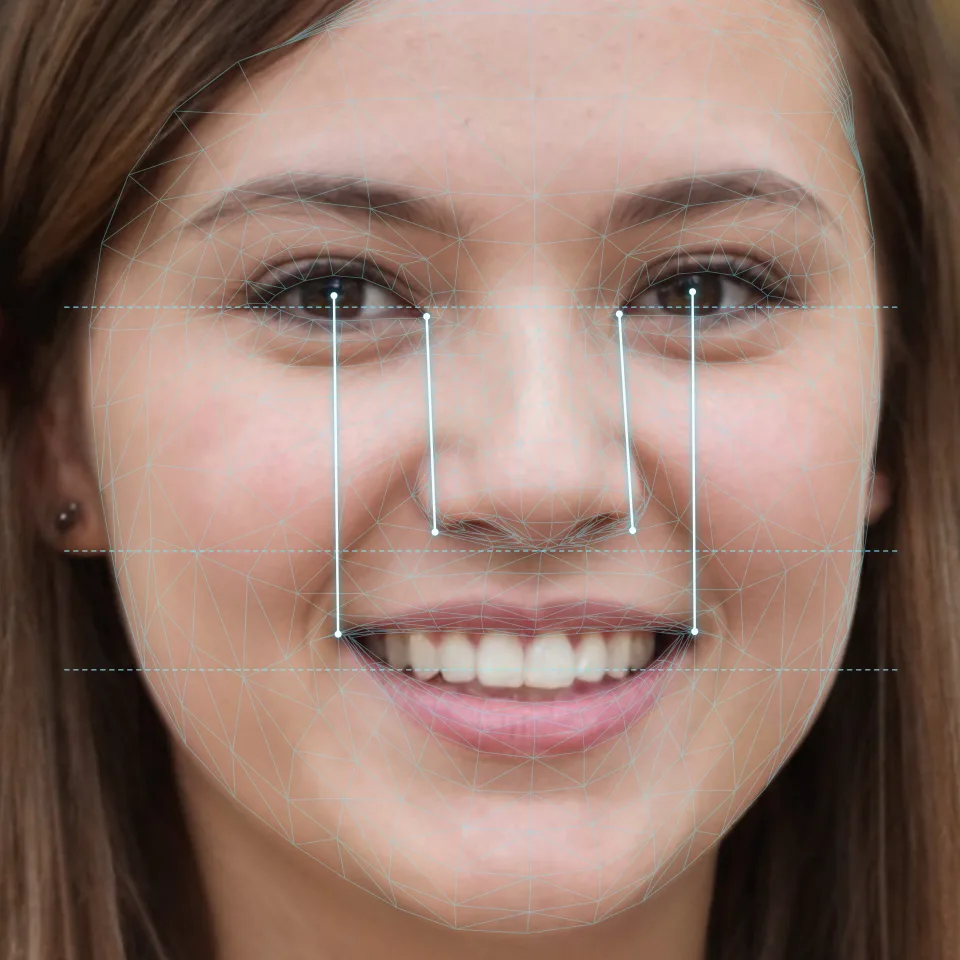
The diagram shows where features sit relative to each other (in pixels):
- The inner eye corners are 144 apart, wider than either eye (120 and 110). By the “one eye between the eyes” rule, the eyes are set wide.
- The nostril wings span 148, almost the same as the eye gap. The first alignment holds.
- The pupils sit at x 374 and 642, the mouth corners at 377 and 644. The second holds too.
Against one rule the face “misses”; the relationships stay consistent. She is smiling, though, which widens the mouth. For measuring, see facial thirds and face proportions.
Why one ratio at a time misses it
Harmony belongs to the whole face. Checking one ratio at a time is like judging an image pixel by pixel: every value can be typical and the whole still clash.
The same write-up gives an example: delicate eyes and a small midface with a very wide jaw. Each part is typical alone; together they look mismatched. Equally, several measures off average in a consistent way can read as coherent.
A 2010 study varied eye spacing and eye-to-mouth distance on women’s faces. Ratings peaked with eye-to-mouth distance near 36% of face length and pupil spacing near 46% of face width: the average of 40 faces, not the golden ratio. See average face.
What a single harmony number hides
Any single harmony number from a tool is a summary, built on someone’s choices.
Some guides describe the method: find hundreds of points, measure a few ratios, score each against 1.618, average. That takes three choices:
- which ratios to include;
- the reference: the golden ratio, or a population’s typical range;
- how to combine them. Averaging lets one high and one low cancel.
It also notes there is no agreed harmony index. Whether 1.618 is a sound reference is covered in is the golden ratio face real.
What hair and makeup change
They change how far apart features look, not the features. This is makeup teachers’ practice, not experiments.
- Brow start: a darker brow head starting inside the inner eye corner draws features toward the center; a soft one starting outside it opens them up.
- Whole face, not one spot: shading only the jaw on a face with a broad forehead can make the forehead stand out more.
- Balance a strong feature, don’t shrink it: the one furthest from the rules is often the memorable one.
- Hair and bangs change the frame. The 2010 study’s authors suggest hairstyle shifts perceived face length and width, and so the ratios; they did not test it.
Check with a front-facing photo, by hand or with a face report built from one.
Harmony, symmetry, averageness: which is which?
- Symmetry: whether left and right mirror each other. Slight asymmetry is universal and rarely breaks harmony. See facial symmetry.
- Averageness: how close features sit to a population’s average.
- Proportion: specific ratios, such as eye spacing or the thirds.
- Harmony: whether all of that reads as one face.
Two limits. Most detailed studies cover a few groups of people, so their numbers don’t transfer. And most use still photos, while faces move: a smile changes the relationships, as on the sample photo.
FAQ
Is facial harmony the same as symmetry?
No. Symmetry only compares left and right. Harmony is how all the features work together. Slight asymmetry is universal and rarely breaks it.
Can you measure facial harmony?
Partly. Eye spacing, nose width, mouth width and the thirds can be measured on a photo. Whether they look like they belong together has no agreed formula.