Contents
Where do Renaissance head proportions come from? A unit, not a faceThree painters, three ways to measureRun the painters’ checks on a photo yourselfWhich rules hold on real faces?How FacialRate does it: the same ruler, taken to the museumFAQKey points
- Cennini, Leonardo and Dürer wrote drawing rules, not measurements of people.
- Two checks to do yourself: middle ÷ lower third, and eye gap ÷ eye length. Sample photo: 0.99 and 1.25.
- In a 3D study of 103 people, nobody had exactly equal thirds or an eye gap equal to one eye.
- Not matching is normal: the rules were approximations from the start.
Where do Renaissance head proportions come from? A unit, not a face
Renaissance head proportions start with a unit, not a model face. A painter can’t measure a figure taller than a wall, so he takes one piece of the face as a ruler and works out the rest.
So first ask which kind of claim a rule is:
- A drawing convention: what painters wrote for painters.
- A measured finding: what researchers got measuring real faces against those conventions.
For the older Greek and Roman rules, see Classical face proportions.
Three painters, three ways to measure
| Who | What they wrote | Kind of claim |
|---|---|---|
| Cennini (c. 1400) | Face in three parts: forehead, nose, nose to chin; one part is the unit for the figure; the figure is 8 faces plus 2 parts | Workshop manual |
| Leonardo | Chin to nose base = 1/3 of the face = nose = forehead; mouth to chin 1/4; space between the eyes = one eye; pupil to pupil = 1/3 of face width | Notebook drawing rules |
| Dürer (1528) | Figures 7, 8, 9 and 10 heads tall | A method for many types |
Leonardo, copying the Vitruvian proportions (hair roots to chin 1/10 of height, chin to crown 1/8), changed some fractions: the foot becomes 1/7 of height where Vitruvius had 1/6. Dürer was bluntest: no single person can be the model, and a stout and a thin figure differ in every proportion, so it is hard to say which is more beautiful.
Run the painters’ checks on a photo yourself
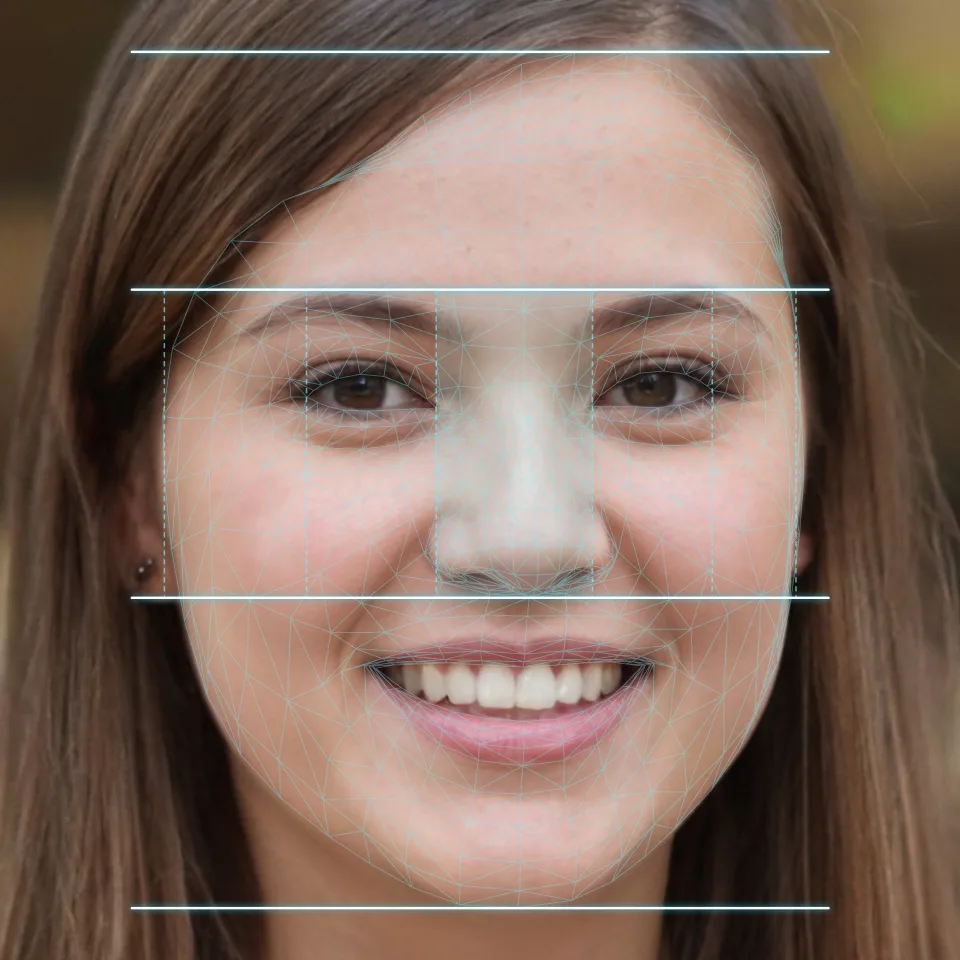
A rule is a hypothesis until you measure. Take a front-facing photo (setup here) and compute two ratios:
- Middle ÷ lower third: brow line to nose base, over nose base to chin. Equal thirds give 1.
- Eye gap ÷ eye length: inner corner to inner corner, over one eye’s length (average both eyes). Leonardo says 1.
The sample photo: thirds of 219, 284 and 286 px, so middle ÷ lower is 0.99. The hairline is estimated, so skip the upper third. The five eyes, left to right: 131 · 120 · 144 · 110 · 77. Gap 144 over an average eye of 115 is about 1.25. The outer fifths differ: the head is slightly turned.
Pixels are fine; the unit cancels. Measure three times: the spread is your ruler’s precision.
Which rules hold on real faces?
These are measured findings.
- 1985: 9 classical canons, 153 young adults. The two most often valid held in only 40% (eye gap = nose width) and 37% (nose width = 1/4 of face width). The vertical thirds fit worst.
- 2012: 103 people, 3D photos, a rule counted as valid within 1.5 mm. Equal thirds: 0%. Eye gap = eye length: 0%; everyone’s gap was wider. Mouth = 1.5 × nose width: 8.7%. Eye gap = nose width: 19.4%.
So the sample’s 1.25 is the usual case, and its 0.99 is one near match among misses. Today’s thirds-and-fifths face proportions descend from these drawing rules. In depth: facial thirds, eye spacing.
How FacialRate does it: the same ruler, taken to the museum
- On your device: the browser finds 478 face landmarks in one front-facing photo and works out 6 facial proportions, such as eye shape, face shape and feature spacing. The photo never leaves the device.
- Same ruler for the works: every work’s face was measured with the same landmarks and proportions; only works that measure reliably are included. They are public-domain sculptures and portraits from open collections such as the Met, the Smithsonian American Art Museum, the Rijksmuseum and the Getty (works that mock appearance or age are excluded).
- A few close works: one beside your photo, a few more equally close, in no order. The sample photo’s closest is Robert Vanderburgh McKim by William Henry Rinehart, about 1867 (Smithsonian American Art Museum, CC0).
- Close means proportions: not looks, and unrelated to the score. The same photo always gets the same works.
- Free first: the free face report shows your face type, strongest feature, three highlights and 11+ dimensions, from a model that learned from real human ratings, not a fixed formula. The art match is in the full report, an optional one-time purchase. More on the art match.
FAQ
Does one eye really fit between the eyes?
That is Leonardo's drawing rule. A 2012 study measured 103 people in 3D: nobody fitted it, and everyone's gap was wider.
Does the art match answer "which artwork do I look like"?
No. It finds works close to you on 6 facial proportions, which is not looking alike, and it ignores your score.