Contents
Classical face proportions: three kinds of claimWhat the ancient texts say: Vitruvius and PolykleitosThe painters’ rules: measuring aidsMeasured: classical face proportions mostly failHow FacialRate does it: your proportions, then close museum worksNext in this seriesFAQKey points
- Three kinds of claim: an ancient text's rule, a drawing convention, a measured finding. Only the last measured people.
- Vitruvius's face rules are simple fractions: 1/10 of the height, in three equal parts.
- Polykleitos's Canon is lost; what survives covers the body, not the face.
- In studies from 1985 and 2012, nobody had three equal thirds.
Classical face proportions: three kinds of claim
Most classical face proportions were written or drawn, not measured. Ask which kind a rule is:
- An ancient text’s claim. Vitruvius, a Roman architect of the 1st century BCE. He doesn’t say he measured anyone.
- A drawing convention. A painter’s measuring aid.
- A measured finding. Real faces measured to see how often a rule holds.
Pull them apart, then measure one photo yourself.
What the ancient texts say: Vitruvius and Polykleitos
Vitruvius used the body as a model of proportion for temples:
- The face, chin to hair roots, is 1/10 of the height; the head, chin to crown, 1/8.
- The face splits into three equal parts: chin to the underside of the nostrils, nostrils to between the brows, brows to the hair roots.
- With arms and legs spread, the body fits a circle centred on the navel, and a square, since height equals arm span.
None of it is 1.618.
The Greek sculptor Polykleitos (5th century BCE) wrote a treatise on proportion, the Canon, and made a statue to demonstrate it. Both the treatise and the bronze are lost; we have Roman marble copies. The surviving accounts describe body proportions and stance, with no rule for the face.
The painters’ rules: measuring aids
- Cennini (about 1400, workshop manual): a third of the face is the unit for the whole figure; ear to ear is one face; the figure is eight faces plus two thirds.
- Leonardo (notebooks): the space between the eyes is one eye’s width; pupil to pupil is 1/3 of the face width.
- Dürer (1528): figures 7, 8, 9 and 10 heads tall, many types rather than one. He wrote that no single person is a model for everything, and that stout and thin figures differ in every proportion.
Today’s drawing guides are simplified heirs of this line; see neoclassical facial canons.
Measured: classical face proportions mostly fail
- 1985: 153 young adults, 9 canons. The most often valid: eye gap equals nose width (40%) and nose width equals 1/4 of face width (37%). The vertical thirds fit worst.
- 2012: 103 people, 3D photos, valid within 1.5 mm. Equal thirds: 0%. Eye gap equals eye length: 0%; everyone’s gap was wider. Mouth equals 1.5 × nose width: 8.7%. Eye gap equals nose width: 19.4%.
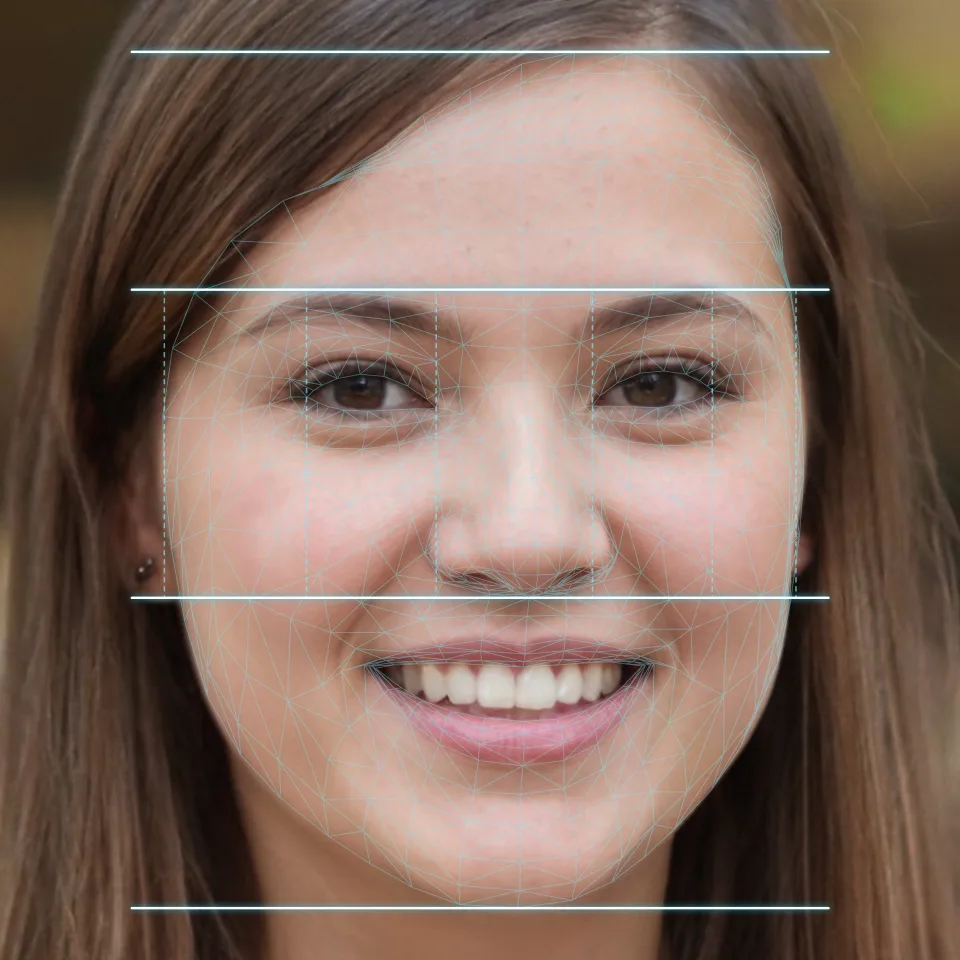
Sample photo (above), thirds: 219 / 284 / 286 px, middle ÷ lower 0.99; the hairline is estimated, so the upper third is least reliable. Five eyes, left to right: 131 · 120 · 144 · 110 · 77. The gap is wider than an eye; the outer parts differ because the head is turned a little.
Measure your own: facial thirds. The 1.618 version: golden ratio face.
How FacialRate does it: your proportions, then close museum works
- The score comes from a machine-learning model that learned from real human ratings, not a fixed formula like equal thirds, calibrated and tested against real ratings.
- The free face report: face type, strongest feature, three highlights and 11+ dimensions. Free, no limit. Tips cover photography, hair, makeup and skincare only.
- Artwork match: on your device, 478 face landmarks give 6 face proportions (eye shape, face shape, spacing of the features and so on). The photo never leaves the device. Each work’s face was measured the same way; only works that measure reliably are included. One work sits next to your photo, a few more equally close, in no order.
- The works: public-domain (CC0 or public-domain mark) sculptures and portraits from open collections: the Met, the Smithsonian American Art Museum, the Rijksmuseum, the Getty and others. Works that caricature or mock appearance or age are excluded.
- “Close” means facial proportions only, not looks, and has nothing to do with the score. The same photo always gets the same works.
It’s in the full report, an optional one-time purchase: title, artist, date, one sentence on where you’re close (no numbers, no ranking) and a comparison image. Unlocking sends one request with a few proportion readings; it isn’t stored. The sample photo’s closest work: Robert Vanderburgh McKim by William Henry Rinehart, about 1867, Smithsonian American Art Museum (CC0). See artwork match.
Next in this series
- Greek sculpture faces: idealised, copied, once painted.
- Renaissance head proportions: how painters measured a head.
FAQ
Which artwork do I look like? Can a face analyzer tell?
An art match compares 6 face proportions with museum sculptures and portraits. It doesn't say who you look like or measure beauty.
Is it normal for my facial thirds to be unequal?
Yes. In two measured studies nobody had three exactly equal thirds. Equal thirds are a drawing convention.