Contents
Greek sculpture faces: why do they all look alike?What we see is usually not the original, and not the original colourThe “Greek profile”: an 18th-century descriptionGreek sculpture faces and the golden ratioHow FacialRate does it: museum works, compared on proportionsFAQKey points
- Classical Greek nudes are idealised figures built on ratios, not portraits.
- Most bronze originals are lost; we mostly see Roman marble copies.
- The statues were painted. White marble is what is left after the colour wore away.
- The "Greek profile" is an 18th-century description, and no ancient evidence ties the golden ratio to Greek art.
Greek sculpture faces: why do they all look alike?
Because they were never meant to be portraits.
The Metropolitan Museum of Art describes Classical Greek nudes as idealised figures whose proportions were based on mathematical ratios. They show health, youth and geometric clarity, not how people differ.
Take Polykleitos’s Diadoumenos, a youth tying a band round his head. Over 40 ancient versions are known, all copied from one lost bronze. They look alike because they copy one idealised face.
Old people and children became common subjects only in the Hellenistic period (323–31 BCE).
What we see is usually not the original, and not the original colour
- Not the original. Very few 5th-century BCE bronzes survive; many were melted down for the metal. Roman workshops took plaster casts from originals and used many measuring points to copy them in marble. The Met’s Diadoumenos is itself ancient fragments joined with plaster casts.
- Not the original colour. The statues were painted. From July 2022 to March 2023, the Met’s “Chroma” exhibition set 14 full-size colour reconstructions beside the ancient works.
So the white marble face is idealised, copied, then stripped of paint. How the faces were coloured, these sources don’t say.
The “Greek profile”: an 18th-century description
A forehead and nose in nearly one straight line is often called the “Greek profile”. The phrase comes from Winckelmann, an 18th-century German historian, describing ancient sculpture, mainly youthful heads; he treated the shape as a standard of beauty. It is a later description of statues, not a rule the Greeks left.
Did the Greeks themselves set numbers for the face? We don’t know. Polykleitos’s Canon was about proportion, but it is lost, and the surviving accounts cover the body and stance. What we have is the statues, mostly copies; to learn their facial proportions, you measure them.
Greek sculpture faces and the golden ratio
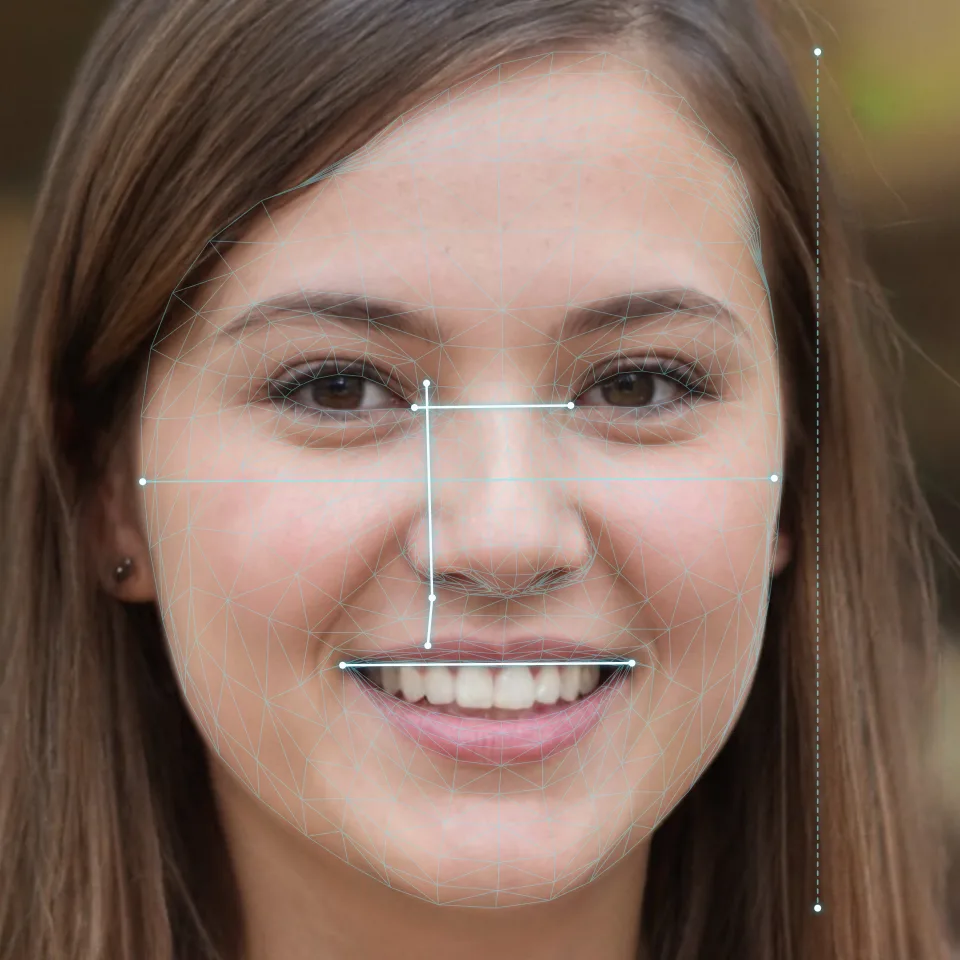
There is no good evidence of a link. A 2024 review checked the claims one by one:
- Euclid describes the division, but only as geometry, with no tie to beauty.
- Calling it a universal law of beauty starts with Zeising, in the mid-19th century.
- The claim that the Parthenon was built on it isn’t supported by measurement.
- Leonardo’s notebooks never mention it, and the text on the Vitruvian Man uses whole-number ratios.
The diagram shows three pairs of lengths golden-ratio guides often measure; try them on your own photo. Some guides also hold the middle and lower thirds up against 1.618. On the sample photo, middle ÷ lower is 0.99, much nearer the equal parts Vitruvius wrote down. There is no ancient 1.618 to check your numbers against. Method: golden ratio face. Evidence: is the golden ratio face real.
How FacialRate does it: museum works, compared on proportions
FacialRate’s artwork match compares proportions, not looks:
- From one front-facing photo, 478 face landmarks give 6 face proportions on your device: eye shape, face shape, spacing of the features and so on. The photo never leaves the device.
- Every work’s face was measured the same way; only works that measure reliably are included. One work is shown next to your photo, with a few more equally close, in no order.
- The works are public-domain (CC0 or public-domain mark) sculptures and portraits from open collections such as the Met, the Smithsonian American Art Museum, the Rijksmuseum and the Getty. Works that caricature or mock appearance or age are excluded.
- “Close” means facial proportions only and has nothing to do with the score. The same photo always gets the same works; a different angle or expression may get different ones.
It is part of the full report, an optional one-time purchase, with title, artist and date and one sentence on where you’re close, no numbers and no ranking. The free face report still shows your face type, strongest feature, three highlights and 11+ dimensions. See artwork match.
FAQ
Were Greek statues white?
No. They were painted, often brightly. The white is what remained after the colour wore off.
Was the "Greek profile" a Greek beauty standard?
There is no evidence for that. It is an 18th-century scholar's description of youthful heads in ancient sculpture, a later idea.
Will an art match tell me which Greek statue I look like?
It compares 6 face proportions with museum sculptures and portraits. It doesn't say who you look like or measure beauty.