Contents
Is the golden ratio face real? Not as a beauty measureA ratio hits 1.618 when you pick the pointsHow researchers tested 1.618 against ratingsThe new golden ratios: 36% and 46%Masks, apps and what explains moreFAQKey points
- A 2008 study tested 19 golden ratios. Only 4 were linked to ratings, and together they explained about 16% of the differences.
- A 2010 study found the best-liked eye-to-mouth distance was about 36% of face length and the pupil gap about 46% of face width, values that match an average face.
- The best-known golden ratio mask was found to use a faulty fitting method and to fit a narrow type of face.
- When a ratio lands on 1.618, ask whether its points were chosen before or after looking at the face.
Is the golden ratio face real? Not as a beauty measure
As a ruler for how good a face looks, no.
The golden ratio, φ ≈ 1.618, is a constant from geometry. The claim that attractive faces follow it comes mostly from popular articles and apps, not research.
Researchers have tested it: people rate a set of photos, ratios are measured on the same faces, and the question is whether faces closer to 1.618 get higher ratings. The link was weak. The proportions people liked best were close to the average of many faces.
But first: when a ratio “hits” 1.618, what does that tell you?
A ratio hits 1.618 when you pick the points
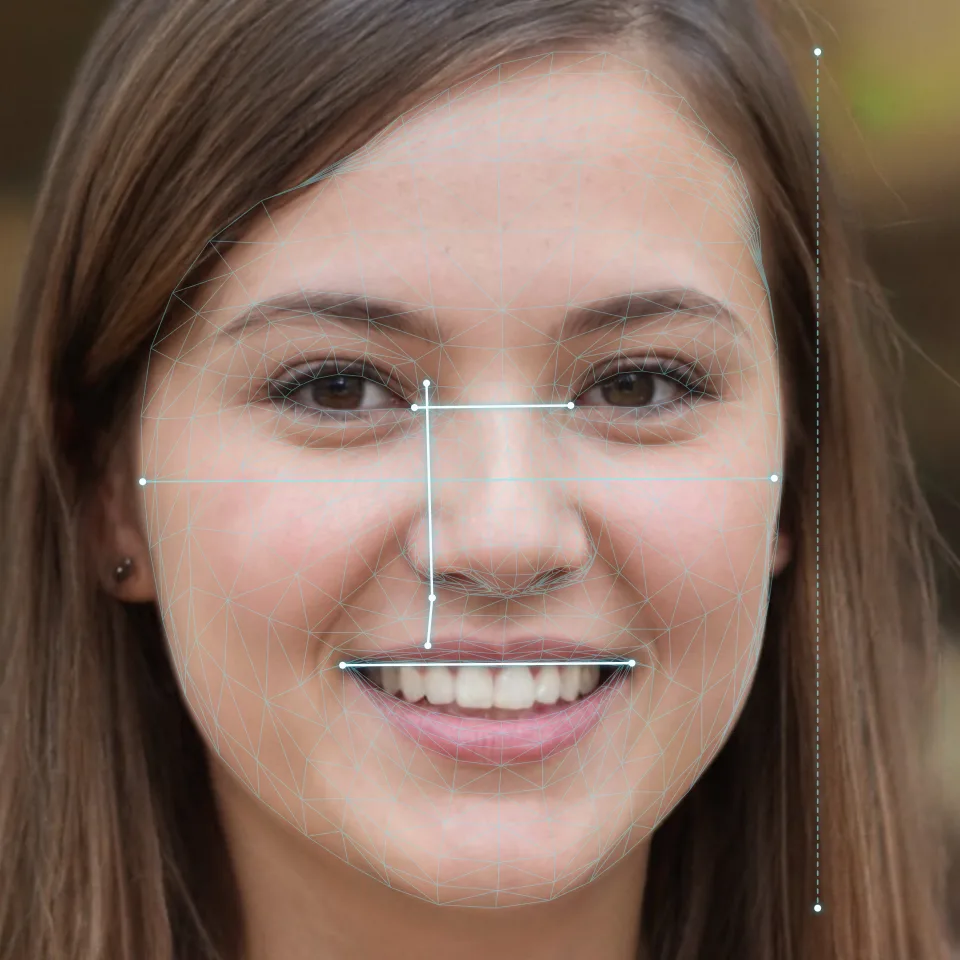
We measured 12 lengths on the sample photo: the three thirds, face length, cheekbone width, the gap between the inner eye corners, mouth width, nose length, the philtrum, nostril-wing width and the width of each eye. Dividing each pair gives 66 ratios.
Only one lands within 5% of 1.618: nose length ÷ the width of the eye on the left of the photo, 198 ÷ 120 = 1.65. Use the other eye and it becomes 198 ÷ 110 = 1.80, which no longer fits.
No guide lists that pair. But if you may choose after looking, anyone can say a face “has the golden ratio”. That is not a measurement. A measurement fixes the points first and reads the result second. How to measure the usual pairs is in the golden ratio face test.
How researchers tested 1.618 against ratings
In 2008, researchers in the Netherlands asked 76 adults to rate photos of 64 teenagers. They marked 13 points on each photo, computed 19 commonly cited golden proportions and measured how far each was from 1.618.
Only 4 of the 19 had a clear link with the ratings: closer to 1.618, slightly higher rating. Together they explained about 16% of the differences. The authors judged that too small to matter in practice.
So the finding is not “no link” but “a small one”. A 2022 analysis pooling raw measurements from 27 articles found that no group’s averages came consistently close to these “ideal” values.
The new golden ratios: 36% and 46%
A 2010 study asked the other way round: edit the photos and let people choose.
The researchers changed the distance between the eyes and mouth, and between the eyes, on photos of women’s faces, and students compared versions in pairs. The best-liked face had an eye-to-mouth distance of about 36% of face length (hairline to chin) and a pupil gap of about 46% of face width. The authors note these values match an average face and differ from a version built on golden sections. The limits: women’s faces only, and few photos.
On the sample photo, pupil gap 268 ÷ cheekbone width 582 also gives 46%. But the study measured face width between the inner edges of the ears, not at the cheekbones. Two 46% figures with different definitions cannot be compared.
Masks, apps and what explains more
The best-known golden ratio mask is a grid of lines drawn from φ. A 2008 paper found the method for fitting faces to it was faulty, and that it best matched the angular faces of fashion models, not the faces most people prefer. Some popular review sites say it lacks evidence.
What explains more? Reviews keep returning to averageness and symmetry: faces close to the average of many faces, and more even left to right, tend to be rated as more pleasant. More in average face and facial symmetry.
Apps like the golden ratio because it is easy to compute and to explain. Easy is not the same as accurate. Next time you see a golden ratio result, in an app or in a face report, ask which points it used, and why those.
FAQ
So is the golden ratio useless?
As a beauty standard, the evidence does not back it. As a guide line for drawing or design, or as a fun piece of maths, it is fine.
Why do so many apps use the golden ratio?
It needs a few points and one division to produce a number, and it comes with a good story, so it is easy to build and to share.
Are 36% and 46% the new standard?
No. They come from one study of women's faces, and the authors say they match an average face. Other faces and raters could give other numbers.