Contents
Nose contour for your nose shape: why does it work?Read the nose on the sample photoShadow and light by readingWhere artists disagree: how close, how longPhoto versus mirror: flash, side light, profileHow FacialRate does it: same light, before and afterFAQKey points
- Contour darkens the sides and keeps the front bright; the nose's edge reads where that boundary sits.
- Long nose: depth at the tip end. Wide tip: a V. Low bridge: start between the eyes.
- Artists disagree on how close the lines go and how long the highlight runs.
- Flash flattens the nose's own shadows and side light deepens them.
Nose contour for your nose shape: why does it work?
Light mostly comes from above and in front. The bridge faces forward and is brightest; the sides face the cheeks and darken. Your eye finds where the bright plane turns dark and reads the nose’s edge there.
Contour adds dark on the sides and keeps the front bright. Move the boundary in and the front reads narrower; darken under the tip and the nose reads as ending there.
So shadow must be broad and soft, since a hard line reads as paint, and it only works in some light; see facial depth. These placements are artists’ habits, never measured.
Read the nose on the sample photo
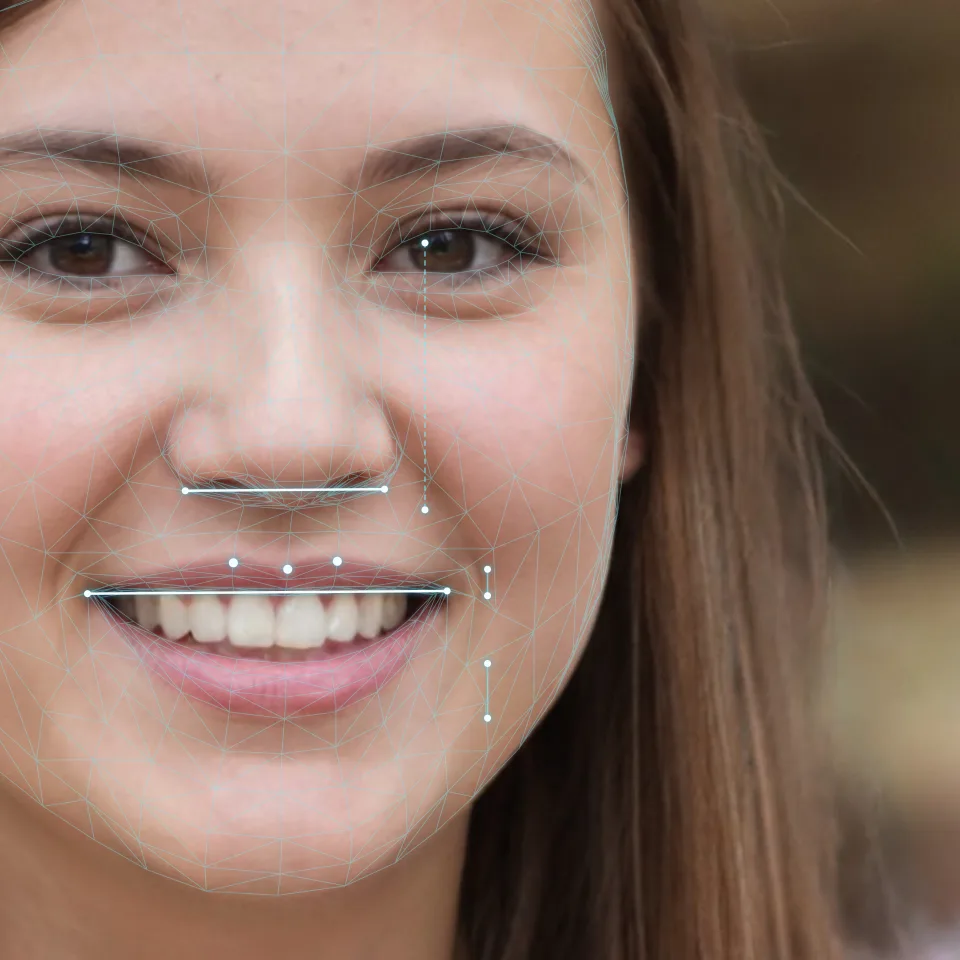
- Width at the wings is 148, against an inner-eye gap of 144. The nostrils at their widest are 179, and she is smiling, which widens them.
- Length is 198, from between the eyes to the base. Width ÷ length is about 0.75.
- Bridge width and tip outline can only be described.
- Bridge height and any bump show only in profile.
How to read each, and the basic method (matte base, start at the brow head, stop above the nostrils, blend inward), is in nose shape types. Below is only what changes per reading.
Shadow and light by reading
| Reading | Shadow | Light |
|---|---|---|
| Wide bridge | Side lines a little further in | Thin centre line |
| Long nose | Tip end and around the nostrils | Dots on tip and below the root, not joined |
| Short nose | No source; by the same logic, none on the tip | A longer centre line |
| Wide or round tip | A V on the tip, a faint line above it | Disputed, see below |
| Wide nostril wings | Yellow concealer by the wings, then a triangle from bridge to wing | Minimal |
| Low bridge | First stroke between the eyes, brushed down | Centre line only |
| Bump in profile | On the bump | A touch on the tip |
The short-nose row is inferred, not an artist’s.
Where artists disagree: how close, how long
- Side lines. Several brand guides say closer lines read narrower. A Chinese-language tutorial warns that pulling them in past your own bridge width breaks the line. A little inward is fine; too much stops reading as shadow.
- Highlight length. Full bridge plus tip, or only the tip and between the eyes, or stopping at mid-bridge because lower light makes the tip read bigger.
- Round tip. One artist skips light there; another draws a small circle on it.
- Depth. Most say one or two shades deeper; one says two or three.
Try both in the same light and compare photos.
Photo versus mirror: flash, side light, profile
From the rules in lighting and facial depth:
- Flash or a ring light comes from the lens. The nose’s own shadows vanish, painted shadow is the only dark left, and unblended edges stand out.
- Front-side light already darkens one side; contour there stacks deeper, while on the lit side it almost disappears.
- Profile shows stripes the front doesn’t. Turn your head when done.
A photo keeps one angle and one light, so test in the light you shoot in.
How FacialRate does it: same light, before and after
- It says a score describes this photo. Light, angle and expression change what the model sees, and contour is light and shadow too, so compare under the same light.
- A free face report with your face type, strongest feature, three highlights and 11+ dimensions, nose and depth among them, plus one tip. Tips cover photography, hair, makeup and skincare only.
- It runs on your device. The browser finds 478 face landmarks; the photo is never sent to a server.
- Free, no limit. Rate my face before and after by the same window; with any face analyzer, keep the photo constant.
FAQ
What shade should nose contour be?
One or two shades deeper than your skin, cool or greyish, no shimmer. Orange shades don't read as shadow.
Why does it show two stripes from the side?
It isn't blended enough, or the lines sit too far out. Turn your head and blend toward the centre again.
Does contour actually make the nose narrower?
No. The distance between the wings stays the same; only where the edge reads changes, in that light and at that angle.