Contents
Facial depth: what does it mean?The planes of the faceWhy light decides most of itWhat changes depth in practiceHow to read depth in your own photosFAQKey points
- A face is a set of planes facing different ways. Planes facing the light read bright, planes turning away read dark; that contrast is the depth.
- In a 2013 experiment, perceived depth came almost entirely from the uneven shading of side light, rising as the light moved sideways.
- Even front light lights both halves equally and adds almost no depth.
- More depth is not better. Before comparing photos, check the light matches.
Facial depth: what does it mean?
Facial depth is whether a photo lets you read front from back: the nose bridge coming forward, the eye sockets set in, the cheek turning under the cheekbone.
The relief comes from bone and soft tissue. But a photo is flat, so depth can only travel through brightness. A surface facing the light is bright; the more it tilts away, the darker. Your eye runs that backwards to tell which way each patch faces.
Two layers, then: the relief the face has, and how much of it this light shows. Only the second changes between shots, and it is usually what people mean by “a photo with depth”.
The planes of the face
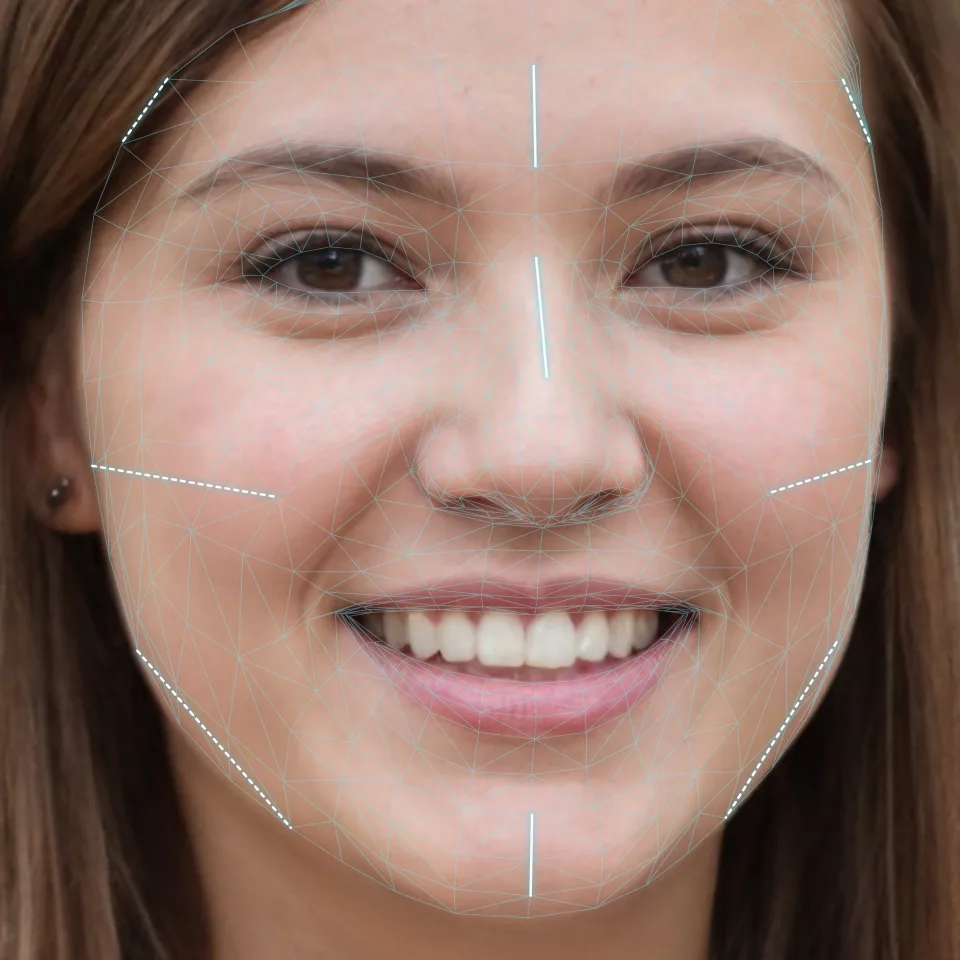
Artists treat the head as a few flat planes. Which way each faces decides whether it reads light or dark under light from above:
| Plane | Faces | Usual light and shadow |
|---|---|---|
| Mid-forehead, nose bridge | Forward | Often brightest |
| Under the brow ridge | Down | Shadowed eye sockets |
| Underside of the nose | Down | Almost always in shadow |
| Sides of the nose | Sideways | Shadow switches side with the light |
| Upper / lower lip | Down / up | Upper lip darker, lower lip lighter |
| Cheek below the cheekbone | Down, if cheekbones are much wider than the jaw | Shadow |
Check the last row on the sample photo: jaw width ÷ cheekbone width is 0.79, so the cheek plane faces down and the diagram draws shadow there. The temples and jaw edge turn sideways and read darker too.
Why light decides most of it
A 2013 experiment moved a point light around two 3D-scanned face models, at head height, from straight ahead to the side: 0°, 15°, 30°, 60°. Each image was split into a symmetric and an asymmetric part.
Symmetric feature edges alone look very flat. Add back the broad, uneven shading from the side light and the face looks about as deep as the original. Depth ratings rose with the light angle in a nearly straight line; symmetric-only images rated as flat as front light, or flatter. Side light also made faces easier to tell apart.
Why: front light lights both halves the same, so the shading says little about which way anything faces.
Limits: two models, seven observers, sideways light only.
What changes depth in practice
- Light direction. The biggest lever: shadow grows as the light moves from front to side. Setups and window light: Lighting and facial depth.
- Highlight and contour. Highlight adds a plane facing the light, so that spot comes forward; contour is a cool, matte shade that imitates shadow, so it sits back. Makeup artists follow the bone, and keep highlight local: shimmer everywhere reads flat. See Highlight and contour basics and the contour guide.
- Camera distance. Too close and the nose is enlarged, depth stretched; far away on a long lens, the face flattens.
How to read depth in your own photos
- Find the light. Look at the nose shadow. Almost none: front light. A small patch under the nose: front and above. Across one cheek: side light.
- Compare like with like. If two photos differ in depth, ask about the light before the face. Depth read from one photo depends on that photo.
- Separate photos for proportions and depth. Measuring, or getting a face report, wants even front light (setup in the facial thirds guide), and that photo reads flatter.
- Depth is not a grade. Flat light smooths skin texture, which is why beauty shots use it; side light shows relief and texture both. Different jobs.
FAQ
Why do faces look flat in ID photos?
They usually use even front light: both halves equally bright, little shadow. By the 2013 experiment, that light carries almost no depth, so the flatness is mostly the light.
Why does my nose look bigger in selfies?
At arm's length the nose is closest to the lens, so it is enlarged most. Step back to 1.5–2 m with a timer for proportions closer to face to face.
What happens if the light comes from below?
The shading flips: what is usually bright turns dark. Research has found faces lit from below are harder to recognise.