Contents
Face symmetry test: three methods, three different answersThe flip test doubles the differenceLeft-left and right-right faces: dramatic, and the least reliableMidline and paired points: know your error firstThe three methods side by sideHow to read a result without over-reading itFAQKey points
- The flip test doubles any difference. It shows that one exists, not where.
- Half-and-half faces change with where you cut and which half you copy.
- Midline points are the most reliable, but a slight head turn distorts them unevenly.
- Only a pair that stands out alone, in three photos, deserves attention.
Face symmetry test: three methods, three different answers
There are three ways to check at home:
- The flip test: a photo beside its mirror image.
- Half-and-half faces: a left-left face and a right-right face.
- Midline and paired points: how far each matching point sits from a midline.
The first two tell you whether there is a difference; the third tells you where and how much. And the more vivid the method, the more easily the photo fools it. All three start from one photo, so shoot it square to the camera, in front light, from 1.5–2 m.
The flip test doubles the difference
Flip a front photo and set it beside the original. It looks strange mostly because you know your mirror face (see the guide to facial asymmetry).
The exaggeration is simple geometry. Say your left mouth corner sits 3 pixels further from the midline than the right. Flipping moves those 3 pixels to the other side, so side by side you see a 6-pixel gap. Exactly double.
So it shows that a difference exists, not its size or place. A photographer’s trick helps: turn the photo upside down. The brain stops reading a familiar face, and what is out of line stands out.
Left-left and right-right faces: dramatic, and the least reliable
Copy one half of the face, flip it and join it on. The two results often look startlingly different, one wide, one narrow. The method does this:
- Where you cut: move the line 5 pixels left and the left-left face loses 10 pixels; the right-right gains 10.
- Which half: a jaw wider on the left makes one face wide on both sides, the other narrow. A slightly bent nose comes out too big or too small.
- What gets copied: moles, partings, stray hair, plus a seam.
- A turned head: the near half is already wider.
Research with these faces is covered in the guide to facial asymmetry. Fun, but not a measurement.
Midline and paired points: know your error first
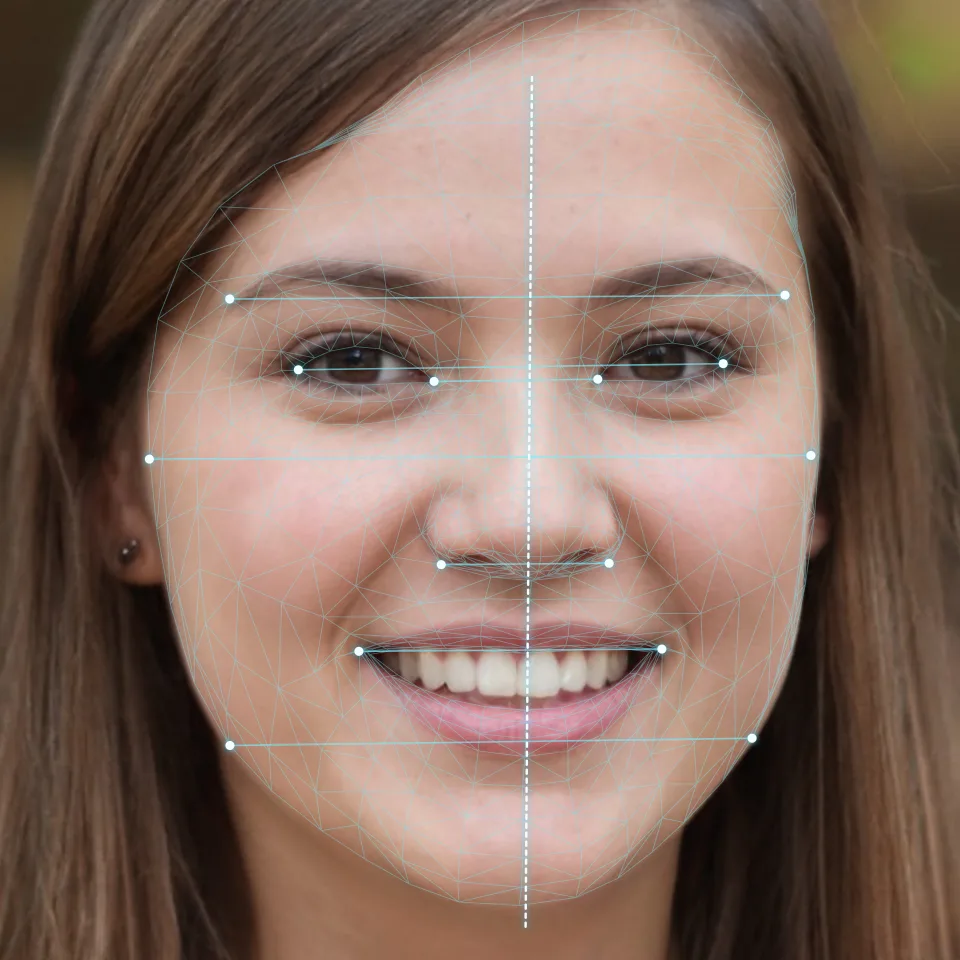
The steps are in the guide to facial asymmetry; here is only the error. If you would rather not place points by hand, a face report built from the same front-facing photo also reads your facial symmetry.
- Head turn is the biggest, and uneven. In that guide’s example photo, a barely visible turn put 86 pixels between the cheek edges and 6 between the nostril wings.
- Tilt shifts heights. A midline tilted 0.4 degrees left one side higher in all seven pairs.
- Clicks wobble. The same point marked tomorrow may land elsewhere.
So measure three photos taken the same way. If a pair varies between photos more than its left-right gap, the gap is noise. Then check direction: all pairs leaning one way means a turned head; one or two pairs standing out alone, every time, is the face.
The three methods side by side
| Method | What it shows | What fools it |
|---|---|---|
| Flip test | Whether the sides differ | Doubles every gap; the strangeness of an unfamiliar view |
| Left-left and right-right faces | Which half is wider or narrower | Where you cut, head turn, copied moles and partings |
| Midline and points | Which pair differs, and by how many pixels | Head turn, tilt, side light, click error |
A turned head fools all three at once. A sensible order: flip to see whether, measure points to see where, keep half faces for fun.
How to read a result without over-reading it
- One photo measures that photo. Light, angle and lens distance can move the numbers as much as your face does.
- Pixels are not millimetres. Don’t compare numbers across photos taken at different distances.
- Small, scattered differences are in every face. A little in several pairs, in no common direction, is an ordinary face.
- One pair that stands out, steadily, is probably the spot you already notice in photos.
Measuring describes; it doesn’t grade. Once you know which spot it is, what to try for eyes, mouth corners and cheeks is in the uneven face guide.
FAQ
Is a face symmetry checker accurate?
Any tool, including a face report built from one front-facing photo, only sees the photo you give it. A turned head, side light or hair over one cheek all go into the result. Trust it when several photos taken the same way agree.
How symmetric is normal?
There is no single line. Small differences in several pairs, leaning different ways, is the usual case. A pair that stands clearly apart in all three photos is a stable difference.