Contents
Face taper: wider on top, as one ratioWhich face shapes taper, and which reverses itCamera angle moves the numberStyling: volume and light where the face is narrowHow FacialRate does it: taper as a readingFAQKey points
- One ratio: face width at the ears ÷ jaw width. Larger means more taper.
- Heart and diamond faces taper most; a pear-shaped face reverses it.
- More or less taper is shape, not rank. There is no "the more V, the better".
- Camera height, tilt and turn all move the number.
Face taper: wider on top, as one ratio
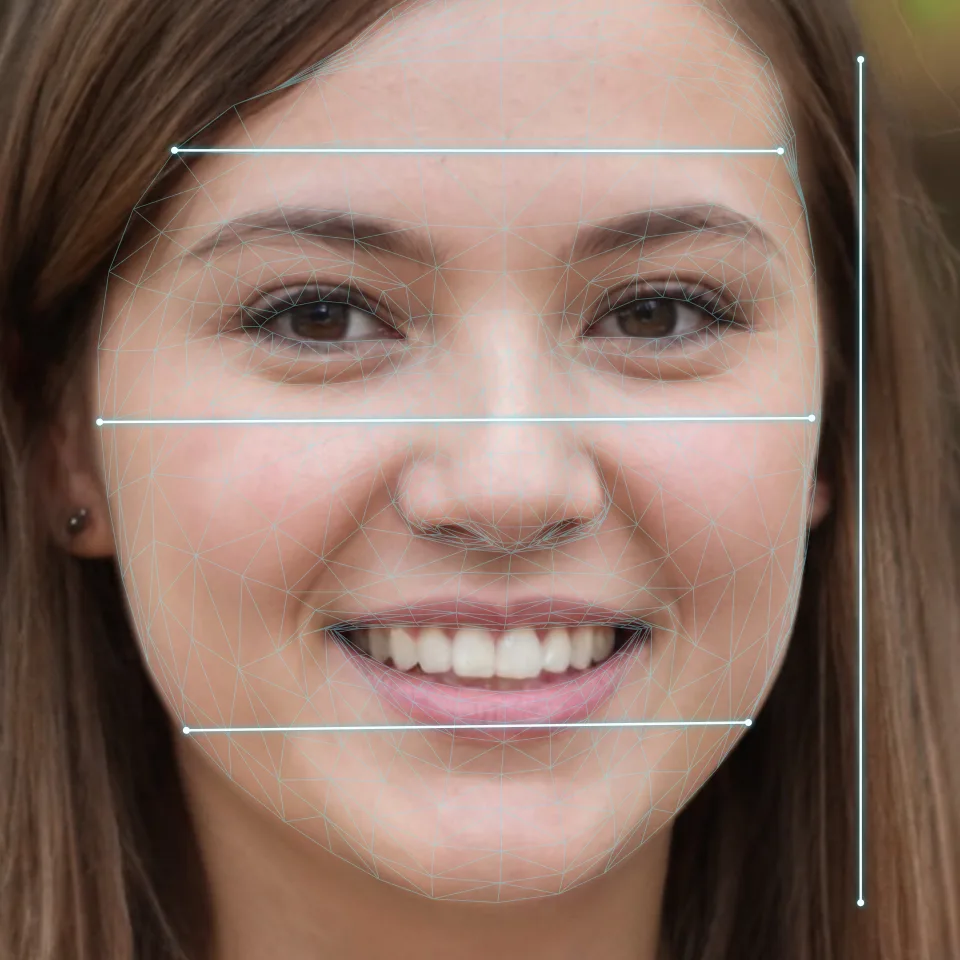
On a front-facing photo, draw two horizontal lines:
- face width in front of the ears, at cheekbone height, usually the widest line on the face;
- jaw width, between the two jaw angles.
Divide the first by the second. Near 1, the lower face barely narrows; larger, it narrows more.
The sample: 582 ÷ 460 = 1.27 (pixels). Put the other way, the jaw is 79% of it. How to draw the lines: how to tell your face shape.
Why divide? Every width grows when the face fills more of the frame, and the ratio cancels that. It cannot cancel close-up distortion, so shoot from 1.5–2 m.
One face-shape guide puts oval faces at about 1.26 ± 0.1. The sample sits in the middle.
Which face shapes taper, and which reverses it
Asking “what face shape do I have”? Add one question: where is the face widest?
- Heart: forehead widest, narrowing to a narrow chin. The same guide gives about 1.37.
- Diamond: cheekbones widest, forehead and jaw both clearly narrower; about 1.31.
- Oval: cheekbones widest, narrowing evenly; about 1.26.
- Square and round: the jaw barely narrows; close to 1.
- Pear: reversed. Jaw widest, forehead narrowest; below 1.
These differ by a few hundredths, so many faces sit between two; see melon-seed face. Japanese stylists add another view: they read an inverted triangle from the width of the sides of the head and a small chin, not from the cheekbones.
The ratio describes shape. It is not a ranking. One perception study we found morphed a single face into dozens of images; that can’t give a number for everyone.
Camera angle moves the number
- Camera height: photography guides say a camera above the eyes makes the face look narrower; below, the chin and underside are enlarged. By geometry, the first raises the ratio and the second lowers it.
- Tilt: chin up shows more of the jaw’s underside; chin down does the opposite.
- Turn: the near half widens, the far half narrows, and the cheek edge and jaw angle move most.
To measure: phone at eye level and 1.5–2 m away, head level, both ears equally visible, hair back. More: head angle in photos.
Styling: volume and light where the face is narrow
Sources agree: volume and light go where the face is narrow. This is stylist practice, not tested.
- Strong taper (heart-like): hair volume at jaw level or below, such as a bob at or just below the chin; a touch of light on the chin’s centre, no shadow along the jaw.
- Cheekbones widest (diamond-like): width at the forehead and jaw, none at the cheekbones.
- Reversed (pear): volume toward the top.
Two points where sources disagree:
- Centre parts: a Japanese guide says a vertical centre part suits an inverted-triangle face; an English guide says a sleek centre part draws the eye to the forehead’s width.
- Volume at the sides of the head: the first says it makes the width less noticeable; the second says temple volume widens the upper face.
The Japanese examples all carry volume at the ends too; that may be the difference. Details: heart face hairstyles, diamond face hairstyles, contour for face shape.
How FacialRate does it: taper as a reading
FacialRate reads this same ratio. The full report’s type breakdown covers six traits behind your face type, and one is face taper: “face width in front of the ears ÷ jaw width; the larger the ratio, the more the face narrows toward the chin.” The full report is optional, a one-time purchase, not a subscription.
The free face report gives your face type, strongest feature, three highlights, one tip and a reading of 11+ dimensions, contour (taper) among them.
Detection runs in your browser; neither the photo nor any face image made from it is sent to a server. And a score describes this one photo: change the angle and the reading changes. Free, no limit on tries.
FAQ
Does a tapering face mean a heart-shaped face?
Not necessarily. Heart and diamond faces both taper; the difference is where the face is widest. Forehead points to heart, cheekbones to diamond.
Is a bigger ratio better looking?
No. It only describes how much the face narrows. No study gives one best ratio for everyone.
Will a face shape detector give a different number in another photo?
It can. Camera height, tilt, turn and hair all move the two widths. Keep distance, camera height and head position the same.