Contents
Chin types from the front: width, height and taperReading it on a front photo: the sample’s chin is 103 px wideIn profile: forward or backChin height: read it inside the lower thirdHair ends, beards and light around the chinHow FacialRate does it: the chin is the end of the outlineFAQKey points
- From the front: width, height and narrowing put a chin on one line, from flat to pointed.
- Chin width is measured across the chin itself, not between the jaw angles.
- Forward or back can only be read on a side photo.
- Chin height belongs inside the lower third, split about 1 : 2 by the drawing rule.
Chin types from the front: width, height and taper
One chin-shape guide sorts front-view chins into five types using three things: width, height, and how sharply the sides narrow.
- Flat: wide, level base; sides drop almost straight.
- Rounded: one gentle curve, no point.
- Oval: narrower and a little taller than rounded.
- Angular: clear edges narrowing toward the centre, without a tip.
- Pointed: narrow, converging quickly to a tip.
It is one continuous line, so many chins fall between two.
A cleft chin is a small dimple or Y-shaped groove in the middle, following the bone beneath. It can appear on any type; we found no styling source on it.
The names describe shape, not grades.
Reading it on a front photo: the sample’s chin is 103 px wide
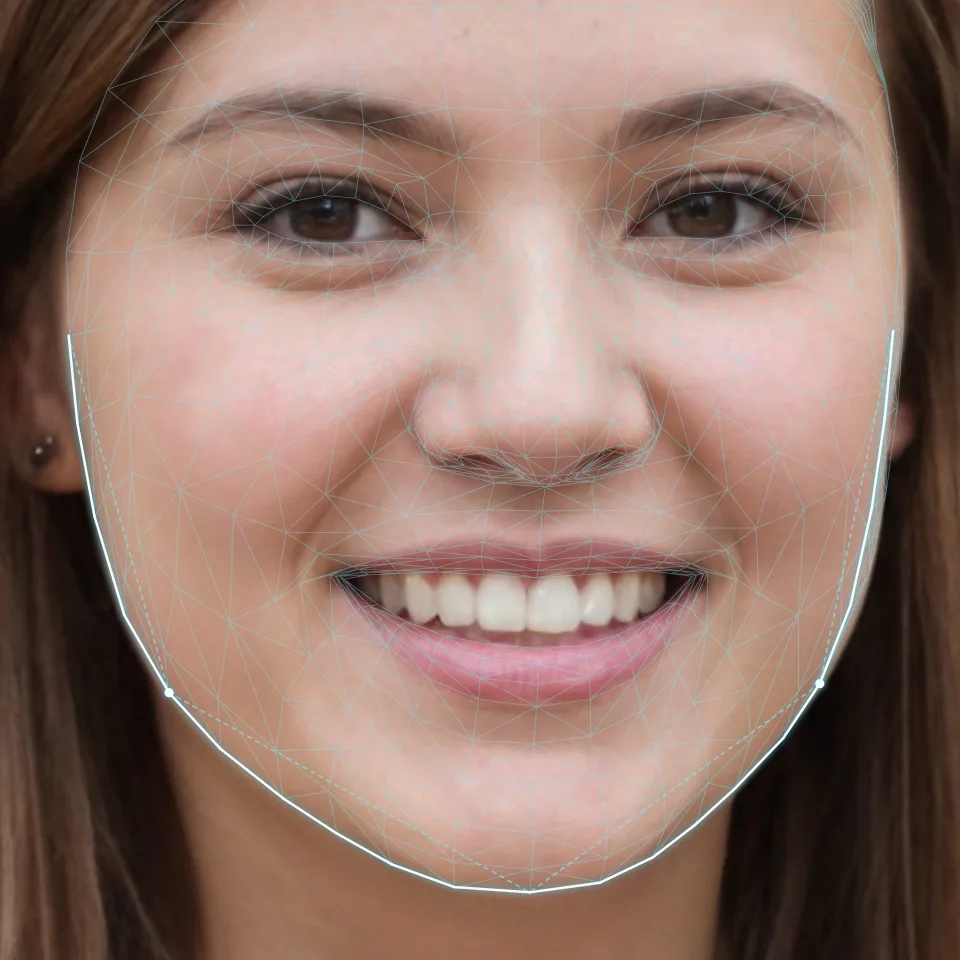
Use a front-facing, eye-level photo with lips closed (setup). Read two things:
- Chin width: across the chin itself, not between the jaw angles. That is jaw width, and much larger.
- How it narrows: follow the outline from the jaw angle. Flat, curved, or converging to a point?
On the sample, the chin is 103 px and the jaw 460, so the chin is about 22% of the jaw. The outline comes in gently and the base curves with no tip: rounded to oval.
One measurement guide says there is no universal ideal chin width. The jaw corner is another question: jawline types.
In profile: forward or back
A front photo can’t show this. Take a side photo, head level, eyes straight ahead. Drop a vertical line from between the brows and see whether the chin’s most forward point lands in front of it, near it or behind it.
- Tilt moves it. Raise the head and the chin comes forward; lower it and it goes back. Compare at the same head position.
- Reference lines differ. Numbers from different ones don’t compare, and soft tissue shifts them. A photo reading describes the photo; it is not a diagnosis.
Chin height: read it inside the lower third
Chin height runs from the crease under the lower lip to the chin’s lowest point. Read it inside the lower third, nose base to chin, which the lip line splits in two. The drawing rule: about 1 part above, 2 below. A rule, not an average.
The sample: 89 above, 197 below, about 1 : 2.2. But she is smiling with her mouth open, so the chin has dropped and there is no clean lip line. So 2.2 is not “a long chin”. Use a closed-mouth photo. Method: long lower third.
Hair ends, beards and light around the chin
These come from stylists and makeup artists, not controlled tests.
- Hair ends: ending at chin level or just below draws a line there and adds width beside a narrow chin. More in jawline hairstyles.
- If you grow a beard: length on the chin reads longer; fuller sides read wider. See beard styles for face shape.
- Light and shadow: several makeup artists point the same way. Shadow at the chin’s centre reads shorter and further back; light under the lower lip reads longer and further forward. Placement: highlight and contour basics.
How FacialRate does it: the chin is the end of the outline
FacialRate finds 478 face landmarks in your browser; neither the photo nor any face image made from it is sent to a server. The free face report gives your face type, strongest feature, three highlights, one tip and a reading of 11+ dimensions, among them contour (taper) and lower third.
It also says plainly that a score describes this one photo: an open-mouthed smile drops the chin, and light and head angle change what the model sees. Using it as a face analyzer, compare photos taken the same way. Free, no limit on tries.
FAQ
Is a pointed chin the same as a V-shaped face?
Not quite. A pointed chin is about the chin; a V shape is the whole face narrowing. A wide jaw can end in a pointed chin.
Does a face shape detector look at the chin?
Only partly. Face shape comes mostly from three widths and length; one guide says chin shape alone does not decide it.
Does smiling change my chin type?
It changes the reading: an open-mouthed smile moves the chin down with the jaw. Read the chin with lips closed.