Contents
Jawline types: how do you tell them apart?Tracing it on the sample photoA photo shows skin, not boneThe second number: jaw width over cheekbone widthWhat each tier looks like, and where hair and makeup come inFAQKey points
- Trace ear to jaw angle to chin: curve, gentle turn or corner?
- A photo shows the corner of the skin outline. The bony jaw angle needs an X-ray.
- Hair, a turned head, a low camera or a raised chin hide or exaggerate it.
- Jaw width over cheekbone width is a separate, independent number.
Jawline types: how do you tell them apart?
Follow one line: from just below the ear, along the edge of the jaw, to the chin. The jawline type is how sharply that line turns, not how wide the jaw is:
- Soft: one continuous curve, no corner to point at.
- Moderate: a turn, but a gradual one.
- Defined: a clear corner at the jaw angle, then on to the chin.
Some guides add a nearly straight line and outlines where jaw and neck blend; three tiers do for everyday use. With a beard, trace the skin along the jaw, not the beard’s edge.
Tracing it on the sample photo
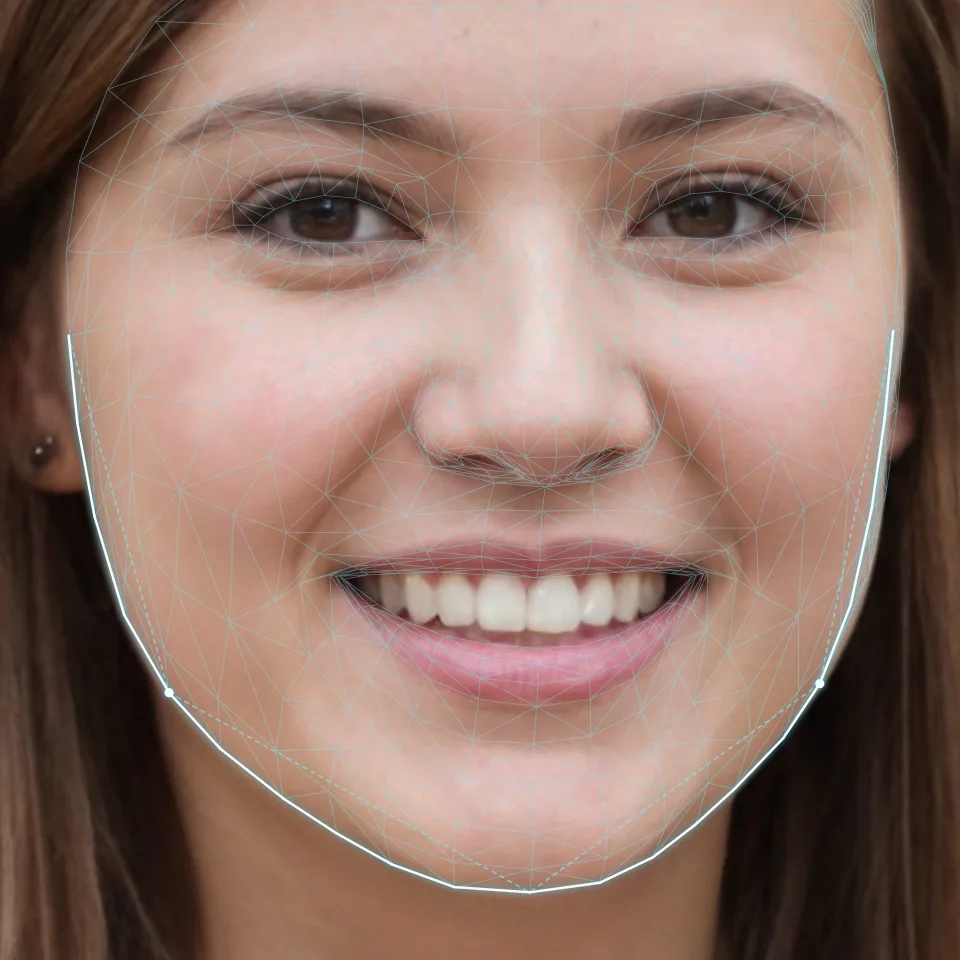
For this jawline test, use a front-facing, level photo with the ears showing; the setup is in the facial thirds guide. Check two things: is the jaw angle a curve or a corner, and does the lower edge run flat or slope toward the chin?
On the sample, the outline turns at about 135° on the photo-left side and 138–141° on the photo-right.
Why two numbers for one face? The head is turned slightly, so the two halves of the jaw meet the lens at different angles: one is seen more from the side, the other more from the front. The projected corner closes on one side and opens on the other. The sides may also simply differ; see uneven face.
The trace shows a gentle turn: between soft and moderate. A face report built from a front-facing photo is another way to see where your own jawline sits.
A photo shows skin, not bone
The jaw angle clinicians measure, the gonial angle, is bone: the angle between tangents to the back and lower edges of the jaw. In adults it typically sits around 120–130°, with most reference means near 125°. It needs an X-ray; a front photo cannot see the back edge.
A photo shows the skin outline, with muscle and fat over the bone. That is why the sample reads 135–141°: the two numbers are not comparable. The “115–120°” figure online comes from a forum, not clinical norms.
The photo reading also moves with:
- Hair over the jaw angle, which hides the corner.
- A turned head, which closes one side and opens the other.
- A low camera, which enlarges the underside of the chin and can flatten the corner.
- A raised chin, which can pull out a corner; a tucked one can hide it.
For steadier photos, see jawline in photos.
The second number: jaw width over cheekbone width
Width is a separate measurement: the distance between the two jaw angles over the widest distance across the cheekbones.
On the sample: 460 over 582, or 0.79. The lower face narrows by about a fifth. The method is in what is my face shape.
They are independent: a jaw can be wide with a soft corner, or narrow with a defined one. One anatomy reference puts bony jaw width at about cheekbone width, or up to a tenth narrower. The few perception studies on the ratio used one narrow set of faces, so they cannot name a best one.
How the two combine into face shapes: jawline and face shape.
What each tier looks like, and where hair and makeup come in
- Soft: light slides smoothly along the jaw; the outline reads as one flowing line.
- Moderate: clear without being hard, with some modelling in most light.
- Defined: light and shadow contrast at the jaw angles; the outline reads at a glance.
None of them needs changing. To show more jawline, tie your hair up or tuck the sides behind your ears. To make the corner less of a focal point, let side pieces fall at jaw-angle height with a little curve. Contour works both ways too; see jawline hairstyles.
This is stylist and makeup-artist experience, not trials; compare photos in the same light.
FAQ
Can my jawline land in a different tier in another photo?
Yes. Head turn, camera height, light and hair move the skin outline by a few degrees, so a jaw near a boundary can tip either way. Compare in the same light and pose.
Is a soft jawline a bad thing?
No. The tiers only describe how the line turns. Norm studies say which angles are common; none picks a best-looking one.
Does chin position count as a jawline type?
No. Chin position is read in profile, a separate measure. A front photo shows the jaw corner and width.