Contents
What is my eye shape? Three scales, not one labelChecking the three scales on a photoMeasuring the sample photoHow Chinese names like phoenix eyes are builtMost people are a mix, and the two eyes differFAQKey points
- The usual eye shape names are the ends of three scales: height ÷ length, tail direction and eyelid type.
- The scales are independent, so "I seem to be two types" is normal.
- Eye spacing is a separate thing, not part of eye shape.
- The two eyes often differ: on the sample photo one tail sits at +4.9°, the other at +7.1°.
What is my eye shape? Three scales, not one label
There is no agreed master list. The common names are the ends of three unrelated scales.
- Height and length: the long end is called almond or elongated; the tall end is round.
- Tail direction: outer corner higher than the inner one is upturned; lower is downturned.
- Eyelid: no crease is a monolid; a crease hidden by skin from the brow bone is hooded; a visible crease is a double lid.
One eye-shape site splits it this way and says most people sit mid-scale, a mix. That is why almond and upturned get confused: one is length, the other tilt, and the same eyes can be both.
So instead of asking “what eye shape do I have?”, ask three questions: how long, which way, what lid.
Checking the three scales on a photo
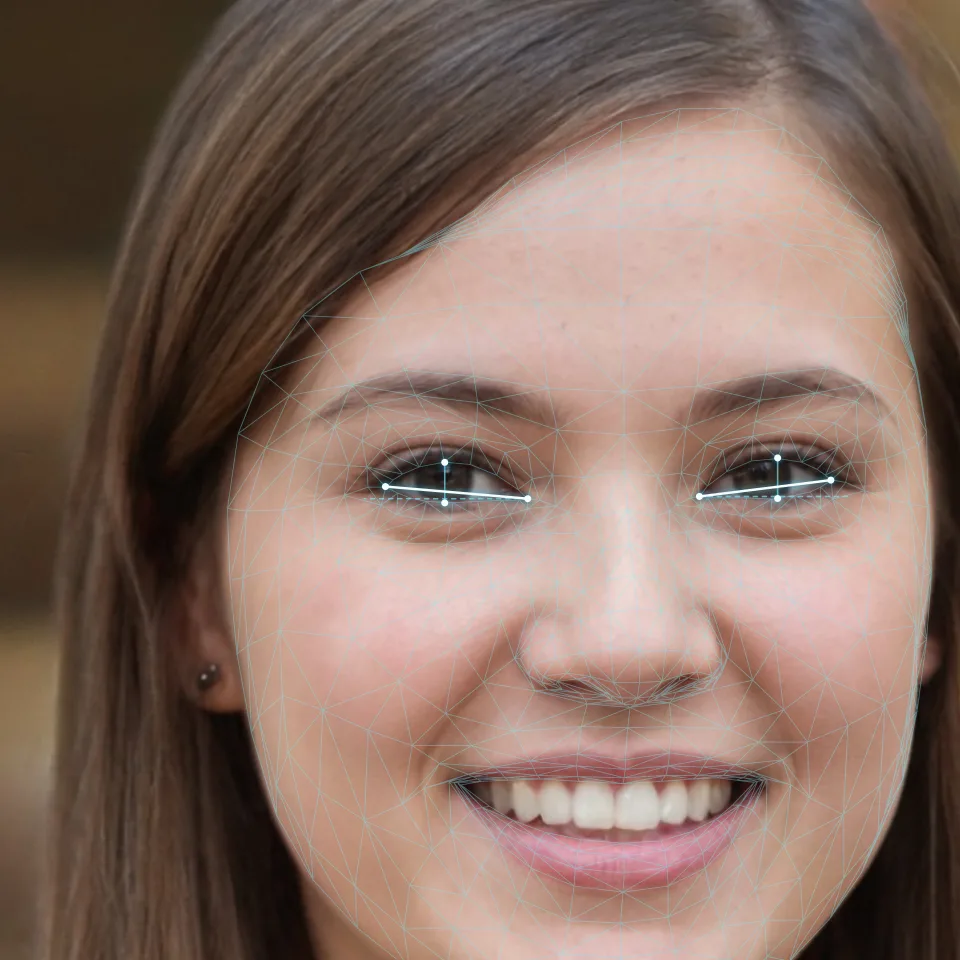
Use a front-facing photo, head level, relaxed face (setup in the facial thirds guide). A free face report from the same photo is another way to see your eye shape.
| Scale | How to check on a photo | Names at each end |
|---|---|---|
| Height ÷ length | Corner to corner for length, lid to lid for height; does white show above or below the iris? | Almond, elongated ↔ round |
| Tail direction | Join the inner and outer corner; compare that line with level | Downturned ↔ upturned |
| Eyelid | Eye open naturally: is the crease visible, does brow-bone skin reach the lashes? | Monolid · hooded · double lid |
A medical glossary prefers “length” and “height” to “width”, which does not say which direction. The first two scales give numbers; the third you judge by eye.
Measuring the sample photo
- Height ÷ length: lengths 120 and 111, heights 35 and 34, so 0.29 and 0.31: over three times as long as tall, the long end. But she is smiling, which pushes the lower lid up, so the ratio reads low.
- Tail direction: +4.9° and +7.1°, both outer corners higher. The average already tilts slightly up, so this gives direction only. Why the two eyes differ by 2.2° is in the upturned or downturned eyes guide.
- Eyelid: a crease shows with the eye open, with a narrow strip of lid below it.
No single reading names her eye shape. Together they say: long, upturned, double lid.
How Chinese names like phoenix eyes are built
Chinese names are combinations too. A Taiwanese makeup site uses three mirror checks: how open the corners are (shown only in a drawing; roughly sharp or blunt), whether the tail sits above the inner corner, and whether the eye is at least twice as long as tall.
- Phoenix (丹凤): sharp, tail up, twice as long.
- Auspicious phoenix (瑞凤): blunt, twice as long.
- Peach-blossom (桃花): sharp, tail up, under twice.
- Willow-leaf (柳叶): sharp, tail not up, twice as long.
- Downturned (下垂): sharp, tail not up, under twice.
- Almond (杏仁): blunt, under twice.
By that test the sample sits between the two phoenix types; only the first check decides. And almond: in English sources it means clearly longer than tall, here the rounder side. Same name, two definitions.
Most people are a mix, and the two eyes differ
“Long, upturned, hooded” and “round, downturned, double lid” are both ordinary combinations; neither is the right answer. An eye-care site notes that two eyes of different shapes are common; the uneven face guide covers why.
Two things get lumped in but are separate:
- Spacing: how many eye lengths fit between the inner corners. The sample is about 1.25; see eye spacing.
- The space between brow and lid: see brow-to-eye distance.
For makeup, the ratio says whether colour spreads sideways or upward, the tail where liner points, the lid what stays visible with the eye open. See eye makeup for your eye shape.
FAQ
How do I tell hooded eyes from a monolid?
Look for a crease. A monolid has none and the lid is smooth. A hooded eye has one, but skin from below the brow covers it when the eye is open.
Why do different photos give me different eye shapes?
Smiling, squinting, a tilted head or a phone held too close or too low all move the corners and the lid, whether you check by eye or with an eye shape detector. Shoot at eye level with a relaxed face for steady readings.
Are deep-set eyes an eye shape?
Not on these scales. Deep-set describes how far back the eye sits under the brow bone, a separate trait, as is a protruding eye.