Contents
Brow-to-eye distance: which gap are you measuring?Measuring the sample photo in eye heightsClose-set and wide-set brows: how each readsTo bring them closer: draw low, take shadow upTo open the space: clean the lower edge, weight downFAQKey points
- Three common methods: brow top to pupil, pupil to brow peak, brow underside to lid. Pick one and keep it.
- Centimetres and pixels change with face and photo size; divide by your eye height.
- Sample photo: 56 and 55 px over eye heights of 35 and 34, about 1.6 on both sides.
- To close the gap, draw on the lower edge and take shadow up; to open it, clean up the lower edge. Makeup artists disagree on whether to close it at all.
Brow-to-eye distance: which gap are you measuring?
There is no single definition. You will find at least three:
- Brow top edge to pupil centre. A makeup school’s tutorial uses this, with a rule of thumb of about 2.5 cm; over 3 cm reads wide, under 2 cm close. No source is given.
- Pupil centre to brow peak. A face-measurement site measures straight up to the brow’s highest point and quotes roughly 18 to 27 mm, noting that bone structure varies a lot.
- Brow underside to upper lid. Japanese makeup artists skip centimetres and set the brow from the eye’s own height.
The three end at different points, and what separates them is the brow itself: its thickness and arch. So choose one method and keep using it.
Measuring the sample photo in eye heights
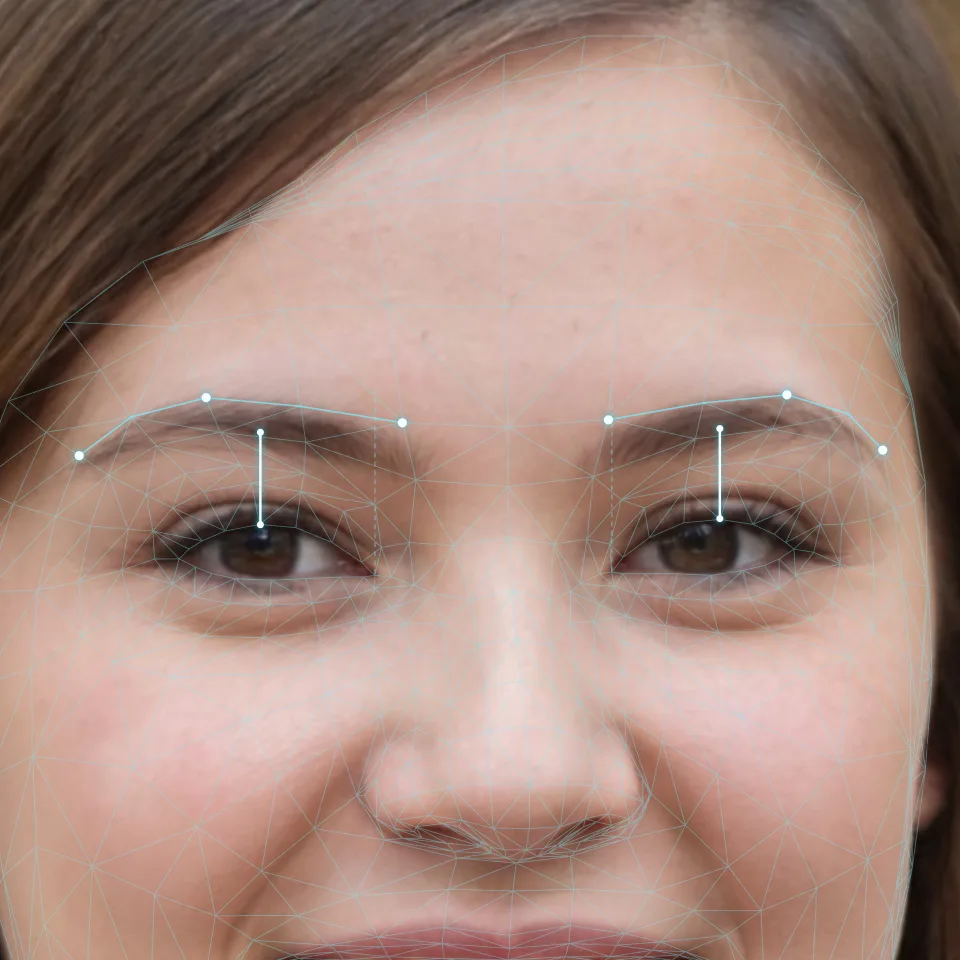
For the photo setup, see facial thirds. Here we use the third method, the bold segment in the diagram:
- Lower edge of the brow to the middle of the upper lid: 56 px photo-left, 55 photo-right.
- Eye height, at the tallest point between the lids: 35 and 34.
- 56 ÷ 35 ≈ 1.6, and 55 ÷ 34 ≈ 1.6.
Why divide? Pixels depend on the photo, centimetres on the face. A ratio has no unit, so you can compare it with your older photos. If you would rather not measure by hand, a face report built from one front-facing photo shows your eyes alongside the other ratios.
She is smiling, which narrows the eye, so 1.6 may run slightly high.
Close-set and wide-set brows: how each reads
- Closer. The eye area looks compact and deeper-set, and the expression reads tighter. One makeup artist adds that up close the eyes look larger, while from a distance the lower face does.
- Wider. The space reads open and clean, the face bright and soft. With a lot of space, the features look spread out vertically.
Both are impressions, not grades. People judge this gap first at the brow head, where it meets the inner eye corner, so the brow head often matters more than the peak.
The space between the two eyes is a separate question; see eye spacing.
To bring them closer: draw low, take shadow up
- Brows. Keep strokes inside your natural top edge, add about 1 mm along the lower edge, and set the head slightly lower. Very fine, sharply lifted brows make the gap look wider.
- Grooming. Tidy from the top; keep the lower edge.
- Shadow. Sweep a little shadow from under the brow toward the bridge of the nose and blend the rest up under the brow.
- Lashes and lids. Curl, add a coat above the iris, and take shadow wider and higher.
Or leave the brow alone and blend shadow from the lash line up to it: the space reads smaller.
To open the space: clean the lower edge, weight down
- Brows. Remove strays under the brow and tidy upward into a slight arch. Draw a firmer top edge, a softer lower edge, in a gentle brown. For shapes, see eyebrow shape for your face.
- Eyes. Keep upper-lid shadow light and below the brow bone; move the weight to the lower lid and lashes; add matte highlight on the brow bone.
Makeup artists disagree. In one Japanese magazine, one fills the brow downward; another returns it to where it naturally sits, with the peak over the muscle that bulges above the brow when you talk; a third fills upward because the sides match more easily. Try both and compare photos.
FAQ
Does smiling change it?
Yes. A smile narrows the eye, so the ratio grows, and the brow peak moves with expression. Compare photos looking straight ahead, not smiling.
Can trimming or tweezing change it?
A little, and only where brow hairs grow. Clearing strays underneath lifts the lower line; tidying only the top keeps it low. Elsewhere, only makeup helps.
Should I aim for 2.5 cm?
No need. It is a makeup school's rule of thumb with no source, measured brow top to pupil. Another method or face size gives another number.
What if the two sides differ?
On the sample they differ by 1 px. If yours differ a lot, check for a tilted head first. Makeup artists start by matching the brow heads.