Contents
How to tell strong or soft features: split the label, then find a referenceThree readings around the eyes, on the sample photoThree readings on the lower face: corner, taper, lower thirdWhat a front-facing photo can’t put a number onOne number isn’t enough: use other faces as the referenceFAQKey points
- Strong and soft are stylists' words, not a measurement standard, and sources list different features.
- A front-facing photo shows six readings: brow-to-eye gap, eye shape, eye tilt, jaw corner, lower-face taper and lower third.
- Feature size for the face, brow and hair colour, nose height and the profile can't be measured on that photo.
- A reading only becomes compact or open, long or short, next to other faces.
- Most faces mix. Neither end is better.
How to tell strong or soft features: split the label, then find a reference
Strong and soft are stylists’ and everyday words, not a measurement standard, and articles define them differently. Roughly, these read stronger: features large for the face, shadow in the eye sockets and beside the nose bridge, a crisp profile, dense dark brows and hair that contrast with the skin, and little empty space between features. It is about the features, not the makeup.
There is no master switch. One article rejects the popular black-and-white contrast test, since lighting and makeup change the result.
Take it apart instead. Use a level, relaxed, ideally bare-faced photo; setup in how to take a front-facing photo.
Three readings around the eyes, on the sample photo
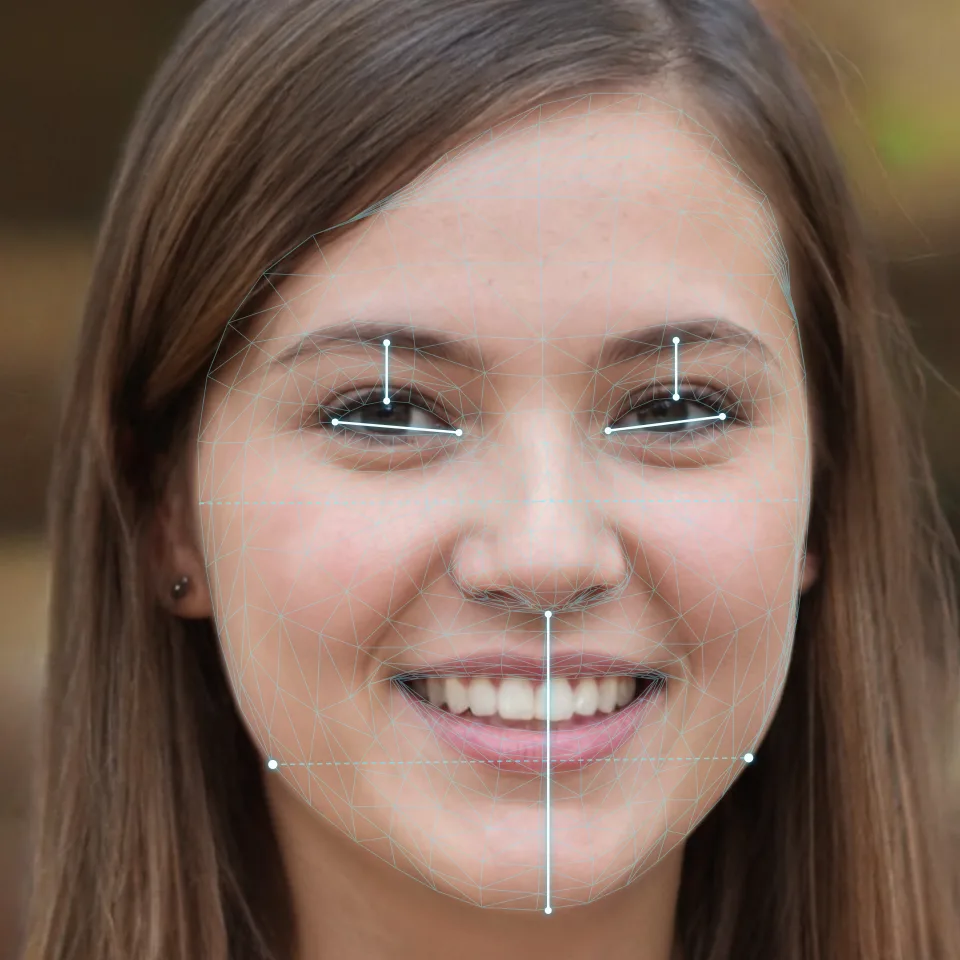
The sample is smiling, so discount the eye readings.
- Brow-to-eye gap: brow’s lower edge to the upper lid, 56 and 55 px, about 1.6 eye heights (0.47 and 0.50 of eye length). Sources talk about depth around the eyes; none names this gap. A flat photo can’t show depth, but it can show how close the brow sits over the eye. That link is our reasoning. See brow-to-eye distance.
- Eye shape: height ÷ length, 0.29 and 0.31. That is shape, not size; sources count eyes large for the face as strong. See eye shapes.
- Eye tilt: 4.9° and 7.1°, outer corner higher. See upturned or downturned eyes.
Three readings on the lower face: corner, taper, lower third
- Jaw corner: about 135° on the photo-left side; one curve, or a visible corner? See jawline types.
- Taper: jaw width 460 ÷ cheekbone width 582 = 0.79.
- Lower third: middle 284 ÷ lower 286 = 0.99. The smile opens the mouth and drops the chin, so this one gets the biggest question mark. See long lower third.
Eye tilt and the jaw say more about straight versus curved lines. Japanese stylists sort faces on two axes: straight versus curved, and proportions such as face and chin length or how high the features sit. Straight does not mean strong: features called strong sit at both ends.
What a front-facing photo can’t put a number on
Some features sources mention have to be judged by eye:
- Size relative to the face: the same eyes on a smaller face read stronger.
- Hair and colour: how dense and dark brows and hair are against the skin. Dye and brow pencil change this.
- Depth: shadow in the sockets and beside the nose bridge, and the profile. That needs a side photo.
- Empty space: features gathered towards the centre pull the gaze inward; spread-out ones spread it. Visual weight, not a ranking.
- Lip fullness and nose height are often listed too.
Sources also disagree outright: Japanese guides put widely set eyes at opposite ends.
One number isn’t enough: use other faces as the reference
The sample’s six numbers don’t make it strong or soft. Is 1.6 eye heights close? Is 0.79 a lot of taper? Only other faces can say.
Ask a few friends for photos with the same distance, light and expression, read all six on each, and see where you sit for each one: an end, or the middle. You don’t need thresholds, and no reliable ones exist.
Expect a mix, such as a close brow, a curved jaw and a mid-range lower third. Several sources say few people fit one side completely; what counts is the overall lean. Neither side ranks higher.
What the words mean: strong vs soft facial features. What to do with your readings: makeup for strong or soft features.
To see which face type your features add up to, a face report from a relaxed front-facing photo shows the closest one and the features behind it.
FAQ
Can I tell with makeup on?
You can, but the readings move. Drawn brows change the brow gap, liner changes the tilt, contour changes the jaw. The words describe features, so a bare face is steadier.
Does a smiling photo work?
Only roughly. A smile narrows the eyes and an open mouth lengthens the lower third. To compare, everyone should use a relaxed, level photo.
Do round eyes mean strong features?
Not necessarily. What sources count as strong is eyes that are large for the face; round or long is shape. Round small eyes and long large eyes are both common.