Contents
Round vs square face: what actually separates them?Why the length ratio can’t tell them apartThe jaw angle: a corner or a curveHow to see the jaw corner on a photoWhat it changes for hairFAQKey points
- Their length ratios differ by a few hundredths, less than the error a close camera adds.
- A square face turns a visible corner at the jaw angle and has a flatter chin; a round face runs as one soft curve.
- On a photo, look at the jaw corner, not the cheeks. Side light and a tucked chin can hide a corner or invent one.
- For hair, round faces usually add height on top; square faces usually add curves near the jaw.
Round vs square face: what actually separates them?
One place: the jaw.
Trace each outline from just below the ear to the chin. On a square face the line turns a visible corner at the jaw angle, then runs along a flatter chin. On a round face there is no turn; one curve carries from cheekbone to chin.
Almost everything else is shared: both are about as long as they are wide, with the three widths close. That’s why the two get mixed up.
Why the length ratio can’t tell them apart
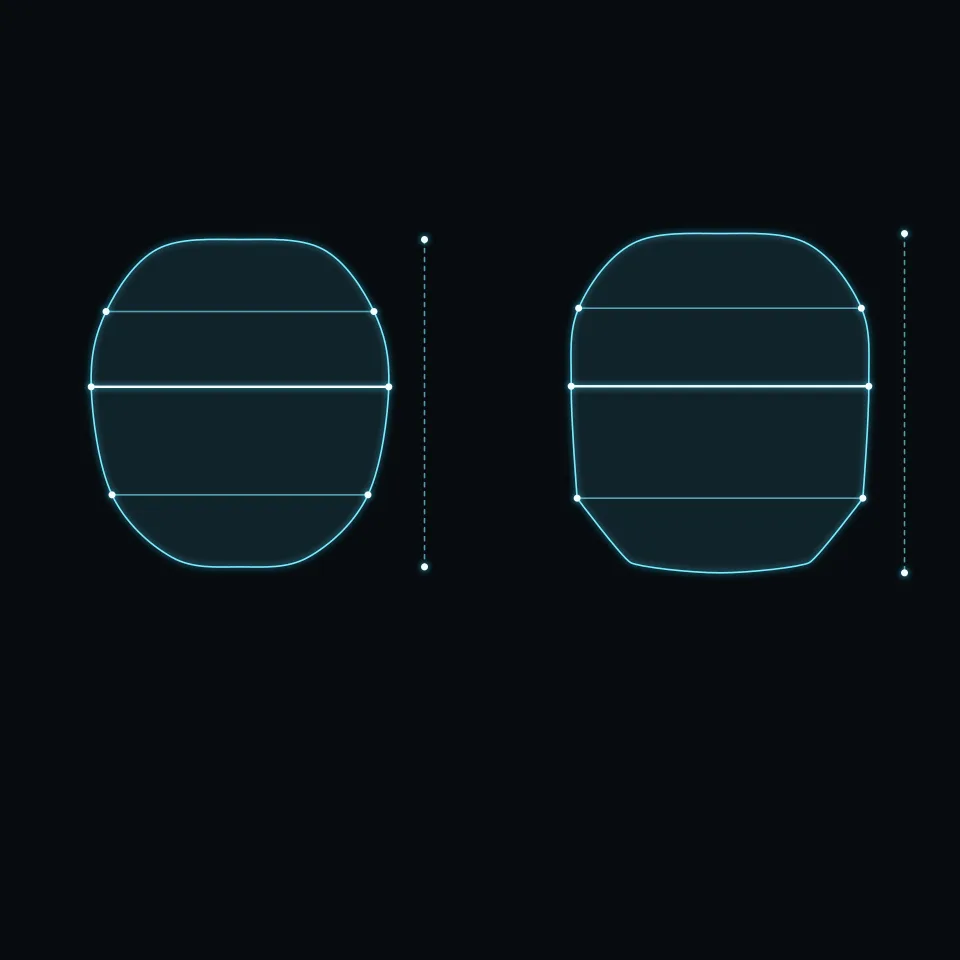
Face length ÷ cheekbone width is the usual first number. Here it does almost nothing. One widely read guide puts round at about 1.13 and square at about 1.16, a gap of 0.03. Another just says both are close to 1:1.
How small is 0.03? Hold the phone too close and the wide lens enlarges the middle of the face, shifting the ratio. Start the length at the hairline instead of higher on the forehead and it moves again. Both errors are bigger than the gap.
The ratio tells you the face isn’t long, nothing more.
The jaw angle: a corner or a curve
The same guide gives rough jaw-angle figures:
| Round | Square | |
|---|---|---|
| Length ÷ cheekbones | about 1.13 | about 1.16 |
| Jaw angle | about 141°, more open | about 130°, sharper |
| Cheekbones to jaw | narrows slightly | barely narrows |
| Jawline | one curve | a clear turn |
| Chin | rounded | flatter, wider |
For reference, it puts an oval face at about 137°, right between them.
Those angles come from one guide’s own method. Another calls a square jaw close to a right angle, clearly a different measurement. Compare angles within one method only.
How to see the jaw corner on a photo
Look at the jaw corner, not the cheeks: full cheeks make both shapes look wide but don’t change whether the jaw turns. Two things mislead:
- Light from one side: the shadow under the jaw draws a hard edge, so a round face seems to gain a corner. Flat front light smooths a square corner away.
- A tucked or lifted chin: tucked, the jawline shortens and the corner can vanish; lifted, it stretches into a sharper angle than it has.
Use a straight-on photo, head level, light from the front. For how to take it and what to measure, see what is my face shape, and a face report built from that photo gives your face shape too.
What it changes for hair
Neither shape needs fixing. If you want the outline to read differently, the ideas differ:
- Round: the face reads short and wide, so the usual move is some height on top and hair falling outside the cheekbones. See hairstyles for round faces.
- Square: the face reads through the jaw’s straight lines and corners, so the usual move is curves: waves starting below the chin, layers grazing past the jaw, side-swept bangs. See hairstyles for square faces.
Both pages say go easy on a blunt bob ending at the chin, for different reasons. On a round face it draws a horizontal line at chin level; on a square face it piles the heaviest hair on the jaw corners.
This is stylists’ experience, not experiments: something to try.
FAQ
My jaw has a slight, soft corner. Which am I?
Somewhere between the two, like most people. Try ideas from both shapes and compare with photos.
Can weight turn a round face into a square one?
It can change the outline you see: fat in the cheeks and jaw changes the width and how sharp the jawline looks.
My jaw has corners but my face is clearly long. Is it square?
Usually not. A square face is about as long as it is wide. Long with an angular jaw is oblong in most guides, rectangle in some. Here the length ratio decides.
Is the jaw always the widest part of a square face?
No. The three widths are usually about equal, with the jaw sometimes widest. The corner matters more.